Monday, June 01, 2009

Bienvenus à Marseille

The flight from Singapore was full and crowded, mostly with Francophone Caucasians. It was however not at all very noisy. Europeans really appreciate quiet, Dad commented. The flight was uneventful, and we landed at Paris perfectly on time. The immigration official shot us his best skeptical look and tried to spot signs potential illegal immigration in us, but in the end decided to let us in after all. Speaking about immigration officials---the immigration counters at Charles-de-Gaulle discriminate not between French and non-French, but between European and other passports, courtesy of the Schengen Agreement. The Schengen area has been a reality for more than a decade, yet it still feels sobering to realise how countries which were at each other's throats less than a century ago can now treat each other's citizens as equals to their own.
The connecting flight to Marseille was delayed for almost 45 minutes due to maintenance work and then air-traffic congestion---four planes in front waiting to take-off, something that always seems to happen at this airport---but somehow arrived only 15 minutes late. Marseille-Provence airport was a very quiet place compared to Charles-de-Gaulle or Changi. The Airbus 319 that flew us there from Paris was the biggest plane we saw there. The shuttle from the airport to the city-centre train station was very smooth, and almost empty. Expensive too. Maybe that's because there are so few people to take it ...
Marseille was full of surprises. Or perhaps surprise is not really the right word to use, because on hindsight they were actually quite reasonable, and probably to be expected. Contrasts or differences might be a better word ...
There is hardly any English here, for one thing. Signages on the road and on public transportation are in French only; most restaurants only have menus in French; English-speakers are few and far in between.
There are also practically no Asian faces here. On the other hand, there are quite a lot of Arab and North African faces, the legacy of the French empire and recent immigration. On the streets and on the bus white faces do not form an overwhelming majority; it still feels like a diverse cosmopolis. But the fact that we are the only East Asian faces we have seen since Paris airport does make the place feel ... a little alien. Alien not necessarily carrying any connotations of anomie, but in the sense of us not belonging here, somehow. The romantic idealist in me likes to deny that discomfort due to racial differences is a natural human instinct; but maybe that belief is only tenable for someone who hasn't yet been in different-enough environments to experience such discomfort personally.
Unlike in Singapore, Sunday is really a day of rest here. Some boulangeries, chacuteries, patisseries and supermarchés were still open in the morning, but by afternoon virtually every shop in the city, less some eating establishments, had stopped operating. On the Rue de la République and the Rue de Rome, the main shopping streets, shuttered shopfronts were all there were to see.
Here we have HDB's. In Marseille ... there's Le Corbusier and his Cité Radieuse. It was like a haute-couture HDB block. Complete with void deck and characteristic corridor. But much more spacious, and with nice touches here and there, such as the red-yellow-blue colour scheme and the ship-like concrete embellishments. It was quite dilapidated though---although they are renovating the facades. The Hotel le Corbusier located in the building, where we stayed, had some fine touches but was generally quite lacking in attention to detail---the wardrobe doors didn't close very well, for example, there was no soap or shampoo provided, there was no telephone in the room or room directory, and so on ... still it was a nice and clean place, and waking up to see the Mediterranean spread out in front of us was a capital way to start the day.

For lunch we had bouillabaisse. It was very hearty. Very. There's one whole basket of fish in that bowl down there. Hardly fine cuisine, though.

After lunch, we ambled around the Vieux Port and then tried to visit the Musée Cantini. That's when we realised some of France's public workers were still on strike.

We wouldn't even have been able to tell if they just told us that the museum was closed because it was a Sunday, or because it was Pentecost.
Surprises notwithstanding, the change of scenery was very welcome. The Mediterranean here is as azure as it was in Beirut and elsewhere; indeed the Corniche John Kennedy, especially the stretches where they were no buildings to disrupt the view, and it was only you, the road and the blue, blue sea, was really rather reminiscent of Beirut's Corniche.

The area near the Cité Radieuse is full of insipid "modern" buildings but the Euromediterrannée buildings near Rue de la République were as stately and grand as Haussman's Paris, and Le Panier, though demolished by the Nazis in 1943, was still full of surprising alleys and unlikely corners, as though it had risen from the ashes in much the same spirit and form.

The day here is really long now ... the sun just set, at almost half past nine. Sunny Provence, indeed.

Sunrise from the Air

Economy class on Air France seemed exceptionally cramped. I apparently stood up to stretch every half-hour even when half-asleep. On the bright side, it meant I managed to watch the sun rise in very slow motion all across Europe. Somewhere over the Black Sea a faint spectrum started appearing, from red near the horizon to blue at the top. Near the Bulgaria coast the spectrum has become slightly more obvious. Over eastern Germany much of the light of the sun has come through and the rainbow has given way to a white-blue spectrum. Near the French border the spectrum grows brighter. Finally the rising sun itself is visible from the terminal building at Charles-de-Gaulle airport.

Saturday, May 30, 2009

Filigree

A fine composition of threads and grains.
Lighted human settlements at night form striking filigrees when viewed from the air ... especially when the lights are isolated. The effect is just like placing a finely-carved gold pendant against a black velvet background.

Wednesday, May 27, 2009

Circles in Thin Ice

Looks like the Lucent Technologies coffee stain logo, no? Except much, much bigger, being formed on a canvas of ice many kilometres wide. Image courtesy of the Earth Observatory.

Regiment, Regulate

Both come from the same Latin root, that for "rule", and carry the same gist of meaning, to bring to order. But regiment, with its strong military connotations, has always indicated a fiercer, more thorough discipline. Whereas to regulate is to direct or govern aspects of something, to regiment is to control it entirely, to subordinate its natural course of being to an overarching, overbearing system from above.

Sunday, May 17, 2009

Serene

I always used to think the Venetian Republic was really trying to appeal to a peace that would transcend the earth in its name. As it turns out, the Serenissima only meant "Most August" ... but then that is the beauty of ambiguity in language. The other meaning has so much more poetry to it.

Insomnia is Great

Yawning Bread, in describing a concert experience not too long ago, posits that Singapore is not yet a great city, at least in part because it is not a sleepless city.
His analysis of why most of the city still closes shop not too late at night and goes to sleep observing a natural, nocturnal schedule, is detailed and convincing. But the link between insomnia and greatness I fail to see very clearly.
Certainly "sleepless" suggests a restless and vibrant energy which could drive the city to achieve greatness, and the perpetual, unending bustle of a truly sleepless city can be in itself an attractive propsect, especially for Chinese so enamored of 热闹. Maybe many of the cities that people would commonly agree to call "great"---London, New York, Tokyo---do indeed have fairly lively cityscapes at any hour of their day.
But why should a city which went to sleep punctually at midnight every day and woke up again with the same energy, or rejuvenated, six or seven hours later, necessarily not be able to achieve "greatness"? Great cities in the past---Amsterdam in the sixteenth century, Cordoba in the twelfth or Alexandria at the turn of the last millenium, for example---were not always sleepless, although some---such as Kaifeng during the Song Dynasty---were.
The link is only clear if, as Yawning Bread seems to have done, it is included as part of the definition of "great" in the first place. What is the basis for this definition? It may be inconvenient for late-night discussions and conversation that public space shrinks so much in the wee hours, but is it not really just that: an incidental inconvenience, and not a fundamental flaw?
Yawning Bread's other yardstick for greatness, I agree with much more, and quote below:
A lot must come from cultural vibrancy, intellectual curiosity and an openness to things new, sometimes to the point of defying convention. The world has to be represented in the city: Different cultures, food, music and ideas from the far corners of the globe, yet in a place with a memory of a past -- a past that is not only respected, but also incessantly questioned. And all these must be out there on the street and in the public square ...
Maybe his point was that such vibrancy is hampered by the fact that the city goes to sleep every day. But really it is only the expression of the vibrancy that is a little muted for part of the day. Compared to the existence of such a beating, living heart in the first place, the city's sleeping habits, or lack thereof, are a completely trivial factor in its "greatness".

Friday, May 15, 2009

Slapstick in Translation

Taking the concept of machine translation to a whole new level.

Sunday, May 10, 2009

Roller-Coaster Ride

Not really. Dad's driving in California was more adrenaline-pumping: "Steer left or you'll hit the curb, Dad."
"What?" THUNK.
Changi Beach was awfully crowded with picnickers and campers, but the sunset view was nice and the roads were actually quite empty.
Oh, and the company was awesome.

Renan's Nation and the Serenissima

Ernst Renan, in a more cynical moment, opined that a nation was merely a group of people united by a common mistaken view of history, and a dislike of their neighbours. But he also gave, in a lecture at the Sorbonne, a much more idealistic and hopeful conception of what a nation is.
After describing nation-states today as 'a historical result brought about by a series of convergent facts', and dismissing various conceptions of the nation---as a dynastic principle, as a racial, linguistic or religious community, as a community of common interest---as inadequate, he sets out his view: 'A nation is a soul, a spiritual principle ... the culmination of a long past of endeavours, sacrifice and devotion ... it is summarized, however, in the present by a tangible fact, namely, consent, the clearly expressed desire to continue a common life. A nation's existence is ... a daily plebiscite, just as an individual's existence is a perpetual affirmation of life.' He describes a nation as something which is actively created and shaped by individual human beings, not something imposed upon them: 'Man is a slave neither of his race nor his language, nor of his religion, nor of the course of rivers nor of the direction taken by mountain chains. A large aggregate of men, healthy in mind and warm of heart, creates the kind of moral conscience which we call a nation.'
Renan's civic nation is just as pure an ideal as the perfectly competitive market: sounds wonderful in theory, but never quite realised in practise. For one, the state, often closely tacked onto the nation, is loath to allow the daily plebiscite to turn up any result not to its liking. And in the case of those (relatively) young states which emerged some fifty-odd years ago from the yoke of colonialism, how far can they be nations?
Renan described the two essential constituting ingredients of the 'spiritual principle' of the nation: 'the possession in common of a rich legacy of memories [and] the desire to live together, the will to perpetuate the value of the heritage that one has received in an undivided form.'
The Serenissima has had a fairly colourful history over its last 190 years, full of development, conflict and traumatic change. But before that? The Singapore History Gallery at the National Museum seems to have had a lot of thought put into it, and is quite well-designed and -curated, but the pre-1819 exhibits are evidently a bit sparse. To a large extent, the Serenissima's history before 1819 is lost in the mists, and has become more myth than anything else. Our 'rich legacy of memories' is not nearly, perhaps, as rich as the nations of Western Europe, or Vietnam, or Japan. Some may bring in the memories of the immigrants from their homelands, the memories of the great civilisations of East and South Asia ... but then such a legacy is no longer the common possession of all of the Serenissima's inhabitants. These memories figure in the recent history and culture of the Serenissima, and their visible footprints and influences will eventually enter the shared memory of the Singaporean nation ... but as yet they do not constitute this shared memory. Still we do have a common memory, still small perhaps, but growing, and we have indeed 'performed great deeds together', even if other, older nations have performed still more.
As for 'the wish to perform still more [great deeds]', I am sure it is not lacking; probably out of a medley of historical and economic concerns, no part of the population seems too eager to secede from Singapore and strike it out as a separate republic.
So, yes, we are a nation. Or at least, are on the way there ... 190 may look a paltry figure to some, but it is nothing to be scoffed at. Over time the legacy will only grow richer, and the 'large-scale solidarity' stronger ... hopefully. Would-be nation-building campaigners take note, this is where your job lies: to consolidate and build the common memory, and to encourage a continued common future. But you would never be able to make it happen alone, without time on your side.

饮水思源

前一阵子又到中学去探访老师了。今年走运被普林斯顿录取了,想回去报喜,还要谢谢老师们帮忙写推荐信。那一天(4月21日)莱初---虽然初中高中今年合并了,统一名为莱佛士书院,但是我还是习惯以往的名称---又正好在举行国民教育活动,让正在服役的毕业生回去对学弟学妹讲讲他们服役的经验,所以在那里碰到了好几个旧同学。
在高中见到了好几位老师,他们都比较关心我们将来大学计划如何;初中老师倒没有那么关心这一细节,而且好像更愿意分享他们(或者学校)现在在做什么。看来还是看待我们的眼光有所不同吧:前者基本上还是把我们当作学生;后者则认为我们已经长大一点,和以前当学生时不一样了。
不管如何,探访老师总是让我觉得很温馨,尤其是看到他们脸上的微笑时。好久没有探访小学老师了,不知他们还在教书吗,还是到别的地方做其他事了?

Saturday, May 09, 2009

When Nature Heals

As in Afgahnistan, so in Iraq. Once Saddam drained the great marshes of Mesopotamia, with the intention of displacing and marginalising the Marsh Arabs. Now, after so much war and chaos, the marshes, along with the rest of Iraq, are slowly limping back ...
(both pictures are true-colour satellite images taken by NASA's Terra satellite. The first picture dates from 2000, the second from 2008.)

Thursday, May 07, 2009

I sympathise, but respectfully disagree

Why must the ability to resolve or accept contradictions necessarily be conflated with hypocrisy? Sometimes it is only the ability to see ever-finer subtleties and gradations in the logic of the world, or to transcend the contradiction altogether and formulate new rules which supersede the old ones. Computers will only see as much as they were built to; any formal system which is intricate and complex enough will, must (Kurt Gödel proved beyond doubt---although he used the irrefutable formal logic characteristic of computers, he arrived at his result through the infinitely malleable insight only humans are capable of---) ultimately be incomplete. Only humans are able to handle the world in its entirety, by comprehending contradictions or ironies in strange, new ways which may turn out to be useful after all, or by riding over them in a Arthur Dent ("what?" with intensely furrowed brows) or Ford Prefect ("who cares, let's go for lunch") way.
So the most important difference between human and computer, between life and machine, at least in my humble opinion, is the flexibility of the logic of life, the ability to keep an open mind, one which can squiggle and wriggle its way out of any contradiction. Because life has to go on, even when one encounters contradictions.
One way such a flexibility would manifest itself is a thoroughly rational mindset. Some things may be a little unsavoury, or to put it in rather more clinical terms, they carry negative externalities. Gambling, drugs, even smoking. The government should tax these things, some say, to discouage people from them. But no, others say, the government should seek to eradicate them altogether, for the suffering they bring is simply not commensurate with pithy cents and dollars, no matter how many of them one can amass. Yes, I agree, money alone will never be adequate compensation for human suffering, for broken families and the miseries of lung cancer. But with the money, measures can be put in place that will help address and alleviate these forms of suffering. And, more importantly, sometimes attempting to eradicate these things expends much more resources, and causes much more misery, than a well-implemented system of controls which may include partial legalisation and taxation. However much we hate to admit it, some less-savoury instincts are deeply ingrained in the human psyche. The instinct to gamble, the instinct to seek instant gratification. Not everyone has the self-discipline to overcome their baser instincts all the time, and moralizing can only achieve so much. Some things, like the instinct to kill, are so destructive it is plainly in everyone's interests to suppress them altogether. In the case of others, such as the urge to gamble, the situation is rather more ambiguous.
One archetypical example used to support the argument against a uniformly hard line is the drug situation in the United States, versus that in the Netherlands. The United States takes an extremely hard official line against drug use and trafficking. Both "hard" drugs such as heroin and cocaine, and "soft" drugs such as marijuana, are illegal, and punishable with harsh penalties. The Netherlands, on the other hand, makes a distinction between the two, and "soft" drugs can be legally sold and consumed in licensed establishments, while "hard" drugs, including heroin and metampthetamines, remain illegal. It is important to note that this is not the same as blanket legalisation. Many classes of drugs remain illegal, and, more importantly, it is still illegal to light up a marijuana joint in the middle of the street. There is still a system of controls in place; it is just that the system aims not to eradicate drug use altogether, but only to control it so that its harm to society is minimised---and the partial legalisation of cannabis is not entirely unreasonable on medical and other grounds. The result of the contrasting policies, which may surprise you, show that the Netherlands has less of a drug problem than the United States. Not only that, rates of violent crime, a phenomenon routinely associated with drug consumption, are lower in the Netherlands than they are in the United States. One may also note that the Netherlands is also (in)famous for legalised prostitution, but that its HIV/AIDS prevalence rates and divorce rates are lower than many developed countries which take a harsher stand towards the world's oldest profession.
I oppose, strongly, the Gahmen's decision to build casinos in this Most Serene Republic. But I must concede that they have put some thought into policies and measures to counteract the possible negative effects of the casinos, and, possibly, just possibly, in the long-run their decision may turn out to have been a reasonable one, on the balance.
The bottom line is, when it comes to such unsavoury activities, eradication may seem a worthy ideal on paper, but sometimes does not work as well in practice as a well-designed, well-run system of controls which will channel "baser" human instincts down relatively harmless, or at least less harmful, lines. Far too often eradication presents a too-convenient slogan for the policymakers, who then think themselves relieved of the duty of fine-tuning their policies and systems of control. Consequently the blunt and unrefined systems of regulation put in place to effect such eradication create plenty of bullshit and cause plenty of suffering themselves. We need to put thought into formulating our responses to these perceived social problems, and must remain open to courses of action which we may initially reject as "immoral", "irrational", or otherwise, if the evidence shows that they are in fact effective in reducing the harm to society. Of course we may note that Singapore has quite successfully tackled the drug issue by taking a far harsher line than even the United States---but this one example does not detract from my main thrust that what we need are well-thought-through responses, not knee-jerk reactions.
Another manifestation of such an inherent malleablity of thought is a healthy sense of irony and humour, and the accompanying ability to feel detachment when necessary. As a policymaker or political leader you supposedly weigh the happiness of thousands, even millions, every day, and your actions may affect as many people. As a military leader commanding an army, a division, even a company, in wartime, hundreds or thousands of lives may hang on your every word. Should you take that seriously? Yes, definitely. Should you be scared of it? I say no. How do you make proper judgements and decisions when you are scared? It is crucial, then, to be involved enough to care, but detached enough to assess the situation and decide coolly, calmly, rationally, wisely. Yes, my actions do matter to many, many people---yet how ridiculous that is! So many people beholden, in that way, to a single individual ... and so ultimately, when it comes to the crunch, the thought should perish, temporarily perhaps, but perish nevertheless, from the decision-maker's head. S/he should only be thinking of whether that was the best decision, and why, not of the horrific consequences for others if it were not. And in the course of everyday life, it should be perfectly normal for him/her to forget, temporarily, about more public responsibilities---lives do not hang in the balance upon decisions of what to have for dinner, or when to go to sleep---until duty calls again.
But anyway, it's dinnertime. (And that, by the way, was the 200th post.)

Friday, May 01, 2009

Hope Springs Eternal ...


Operation Enduring Freedom almost eight years ago. It has caused untold misery and suffering to the Afghan people, and even now many parts of the country are plagued with militancy and insurgency. Meanwhile, the warlords of old continue to exercise effective control over many of the other parts, and their arbitrary and unhelpful rule continues. Amid this large expanse of tragedy, the new Afghanistan's first national park would seem a trivial non-event.
Let us, though, not be too hasty to dismiss it entirely. OEF set off shocks which will reverberate around the region---one of the sad consequences of this being Pakistan's border regions going all awry---and the world for decades to come. But it cannot have been all bad for the Afghans. Their plight is still pretty lousy, but it is perhaps at least somewhat better than it had been under the Taliban. The national park is just one of many signs of a slow, shaky, uncertain, but definite return to normalcy, to a functioning state. Schools are opening, the police is being cleaned up, Kabul's writ is slowly extending outside Kabul. Afghanistan will still be a mess for a while. But a clean-up is surely in progress, and, hopefully, it will eventually achieve something substantial.
I am in no way arguing that Bush was, in the final analysis, justified in attacking Afghanistan in the first place. Only that, now that it has happened, we can still hope for the best.

(Image courtesy of the Earth Observatory)

Wednesday, April 22, 2009

Purity of Arms

Don't you feel it will always be a little ridiculous to talk of the purity of arms when there is blood on your hands? No matter how "justified" the war might be. And to think the IDF put it in its code of ethics.
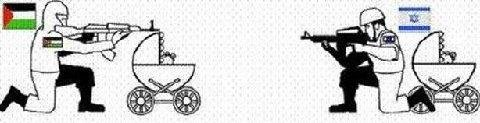
I do not think it is entirely fair to argue, as someone did in a comment on Global Voices Online, that "when hundreds of civilians are dying as a result of the “surgical” attacks of Israel there is no excuse. These are war crimes." The following editorial cartoon presented an entirely probable, and possibly more accurate, version of why surgical strikes in Gaza are still creating collateral damage:
Both sides are, in their quest of security, doing things that could, conceivably, be war crimes, because they do not see viable alternatives.
It is, really, an unfortunate conflict born of misunderstanding and block-headedness. In this light, it is utter nonsense to talk of the purity of arms. What purity can be associated with arms which are tainted with blood shed out of incomprehension, miscommunication, prejudice?
On the ground, however, slightly different realities prevail. Not every Israeli soldier or Palestinian is equally unwillingly to talk to the other side; some, perhaps many, are open-minded and intelligent enough to see that compromise and accommodation is the best possible endgame for both sides. But the conflict perpetuates itself: by creating dynamics that reinforce mistrust, it persuades even open-minded and intelligent people of the necessity of fighting for their lives and dignity. For a combattant who genuinely believes s/he is defending something worthy, against genuine enemies, the notion of purity of arms may be more than just a meaningless chimera.
But what is genuinely worth defending means different things to different people---no Palestinian would agree to defend Israel's right to continue to occupy the West Bank---and who on earth is a genuine enemy? Maybe the IDF soldier is a genuine enemy to the Palestinian suicide bomber, because s/he is an occupier of Palestinian land---but the converse holds as well. There can be no meaning, beyond the entirely subjective, assigned to the part of Purity of Arms that involves the justness of the cause, and "Loyalty to Country" probably encapsulates what the IDF wanted to say in this regard, more clearly and much more frankly.
What about the part that involves humanity in means? This might have some meaning, but it can only ever be an ideal to strive towards, not something that can be achieved, because war is an inherently nasty business. No matter how surgical your strikes are, there is, as the recent balance of evidence goes to show, bound to be some collateral damage, especially if your opponent is hiding amongst civilians. No matter whom you kill---innocent old man, footsoldier, terrorist mastermind---you would have ended the life of a breathing, thinking, feeling human being, who probably had a family who cared for him/her. Any way you look at it, there will still be blood on your hands. And no matter whose blood that is, and how tainted you say it is, it will detract from the supposed purity of your arms.
But of course, ideals serve their purpose too, as reminders of what should be. The situation in Israel and the Palestinean territories could be better; but it could have been worse, without the voices of reason of which Tohar HaNeshek is a part.

新疆人,辛苦你了

想必写这篇文章的是汉族人吧,要不然受了这么多委屈后怎会还肯坦然地宣布:“新疆,是祖国版图不可分割的一部分;新疆人,是十三亿中国人的一部分”,怎愿意只渴望同胞们体谅和感谢,而不要求更多的发言权和自治权?
但也可能我错了,也许新疆人已经有了超越民族分隔的国民意识。他们在抱怨不平的同时也能考虑到整个国家的利益,而且因为爱国,因为对国家有认同感,所以愿意在某种程度上为了国家的前进而牺牲自己的利益。
其实,我们不需要太关心作者的身份。无论是汉族,还是维吾尔族、蒙古族、哈萨克族;无论到底是不是新疆人,甚至是不是中国人,这是次要的。作者显然不在主张闹革命或者政变,而是在真切地述说新疆人的痛苦。我们因此应该重视文章的内容,注重解决里面提到的问题,例如新疆人就业机会不足,教育等发展需要的设施不足,原子弹测试留下的后患等等。
这些问题如果不得以解决,都可以成为新疆人民对政府不满,导致不稳定的原因。有网民作出反应,表示其他地区在过去也曾为国家的利益作出牺牲,这是完全正常的事,没有什么可诉说的。我不以为然,牺牲也许是必要的,可是至少也应该众所周知:让人们意识到,前进是在部分人的牺牲的基础上建起的。
西部大开发,当年办得轰轰烈烈的,后来在公共论坛上也就没有多少下文了。这篇文章正在提醒我们,大开发还没有达到把大西部的发展规律水平拉上来的目的,还必须开发下去;还有,一定要记得,开发不止是公开对东部、公开对外界,它还包括发展。

Saturday, April 18, 2009

Pealing and Tolling

A peal is technically a set of bells, or a change rung on a set of bells, a sort of melody that comes out of ringing tuned bells in a particular sequence. To peal the bells is to play such a sequence on the bells, and is usually done in celebration, of a festival, an accomplishment, or simply out of spontaneous joie de vivre. To toll the bells is to ring the same tone, slowly, in a gesture of mourning and commemoration.

Weedy

Scrawny, with no fat on it. Like an emaciated garden weed, in other words. Isn't it a little derogatory towards the horizontally less-endowed, though?

Turbo Hand-Waving

'"Abstract nonsense" is a nonderogatory term that is commonly used by mathematicians when skipping over parts of an argument that can be proven through a commonly used long and theoretical argument with which readers are expected to be familiar. The usual usage is something like, "...from which the result can be shown through abstract nonsense."'

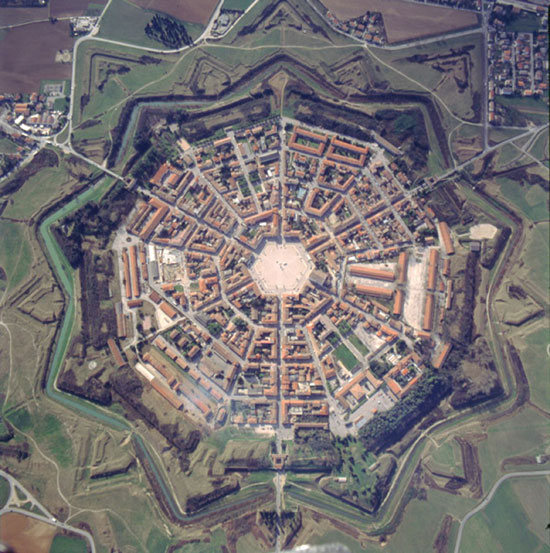
Palmanova, Italy

A nine-pointed star, perfectly formed. NASA's Earth Observatory produces an even more striking image of the star fort amidst the surrounding patchwork of fields.

Exemplar, not Example

Sometimes it is difficult to tell, because those two have meanings which very much overlap. Both came from the same Latin root, from the verb meaning to take out, perhaps to exhibit as an example. Both can refer to a typical instance (Monet's Impression: Sunrise is an example of Impressionism), or a similar instance (US involvement in the Vietnam War may have provided an example for Bush's headlong charge into Iraq).
But exemplar can also refer to the archetype, the original model of something (the extended real plane is the exemplar, not just an example, of projective geometry), whereas example has no such meaning. That is the essential difference. The original model, versus just another model. So even though the adjective is exemplary, only example is used to refer to conduct worthy of imitation. It is as if the adjective referred to a Platonic ideal of conduct which cannot be reached, only approached, by imperfect concrete examples in the real world.

The Region? What's That?

Every once in a while someone will lament how Singaporeans are woefully ignorant of their region. Harry did it again just recently, I believe. Nonetheless, lack of awareness of the surrounding region may not be a uniquely Singaporean problem.
Does it matter? Our neighbours are much, much larger: they have large resources of their own, reserves of land and forests and minerals, and multitudes of consumers, which we can only dream of. Their need for increased integration within ASEAN, economically and otherwise, may not far less pressing that ours. But surely they will be better off with the fruits of integration, even if they can live without it. And moreover, the matter will eventually impact us ...
Contrary to popular belief, it is actually possible to clap with one hand. It does, however, take significantly more effort, and the hand that is doing the clapping cramps up rather quickly. Similarly, continued co-operation and closer integration within ASEAN, which Singapore is so eager to see, is difficult to sustain by the efforts and enthusiasm of any one of its individual members alone. Awareness of the region amongst people throughout the region, then, not just here in the tiny Serenissima, should be a legitimate concern for policymakers and thinkers here, not just something that is vaguely interesting, but strictly not necessary, to ponder over.

Apprehension

In the first instance, to take hold of or to seize, in a quite literal sense. Then, to understand: for the mind to grasp. Next, once knowledge is attained, anticipation of future consequences, which the mind grasps eagerly from its deductions. And finally, it seems, fear of those consequences, dread of what has yet to happen, but is sure---so suspects the mind, somewhere deep inside---to happen.

Thursday, April 16, 2009

Grrr

Have you ever been so annoyed by a problem or mystery that you simply insist on solving it? One day I'll master cofinality and Hartogs numbers and large cardinals. But not now. There are other things to take care of now.

Sunday, April 12, 2009

Mr. Market's Friends

It's not free markets operating alone in a vacuum that are supposed to work Chicago-school magic, it's
markets operating in the context of property rights backed up by the rule of law and a degree of trust among strangers.
And never you forget that.

Elementary but Involved

Look at Erdös' proof of Bertrand's postulate. The guiding argument is clear, but all the supporting details seem to fly in from all over the place and land in just the right spot. 'Elementary but involved' was really a good description. It shows what I conceive of as the two-part ultimate obstacle course of solving a problem. First spot the route--devise the argument. Then follow it up--supply all the supporting details--to reach the summit--the solution.

Visualising the Counter-Intuitive

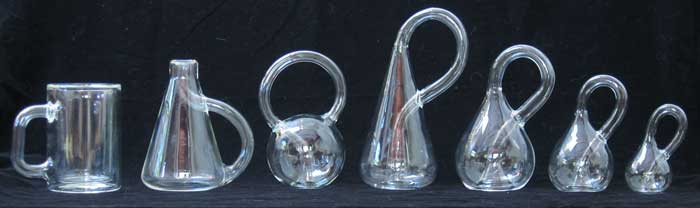
Imagine a circle. Easy. Now imagine a cylinder. Still easy. A Moebius band? Not too difficult once you understand what it is. What about a bottle that has no inside or outside?
Might be a bit harder. Now you are told that the bottle can be constructed by gluing two Moebius bands together along their boundaries. The difficulty mounts exponentially. Computer animation can help.

The smooth, infinitely dense material that is the idealised mathematical surface embedded in space, as well as idealised space itself, has extremely counter-intuitive properties--only more proof, really, that actual matter is discrete, not continuous: you cannot keep breaking it down without eventually reaching some sort of indivisible component. If you could, it would share the bizarre and mind-boggling paradoxes that idealised surfaces, with their continuity, present. There's, for example, the Banach-Tarski paradox: the ball (in mathematics, that specifically refers to the inside of a sphere, a sphere without its skin as it were) can be divided into six pieces, which, after being rotated and moved around in space, then form two balls, each of the same volume as the original.
A only slightly less strange result is a theorem of Stephen Smale which states, among other things, that the surface of a sphere can be turned inside out smoothly. What exactly this means, and how this can be done, is the subject of the illuminating video Outside In.

The video was the work of the Geometry Center at the University of Minnesota (why their site is hosted on UIUC's servers I can't quite fathom). This research centre, which operated from the 1980s till 1998, focused on the 'computation and visualisation of geometric structures'--in other words, using technology to make it easier for us to see what things that the mathematics says must exist, but are too strange for us to imagine unaided. Another of their works, Not Knot, about what we would see if we lived in a space with certain points removed--it's nowhere as simple as just seeing some sort of black hole where the removed point is--is also available as a streaming video.
A good example of technology extending our horizons, no?

Sunday, April 05, 2009

Vietnamese Artillery in Laos?

Maybe this is old news. But supposedly Vietnamese artillery was at it again just a few days ago.
And there's barely a whisper anywhere in the media about it. The Straits Times doesn't say anything. Neither does the New York Times, International Herald Tribune, Times of London, Le Figaro, Le Monde, the Bangkok Post, the Vientiane Times or Xinhua. And Google News only has it somewhere down the middle. There was only news about Hmong refugees in Thailand and their repatriation. The Bangkok Post reported a statement from Vientiane relating to Hmong repatriation which would have sounded perfectly in place in the middle of Catch-22.
You'd think the fact that a foreign army was firing field artillery against alleged rebel guerillas in any country's borders would be major news. Apparently not. Apparently it's still part of the world's most secret war. Supposedly Xaisombun Special Zone, where all this bullshit is supposedly happening, doesn't even exist anymore, because it was dissolved and parceled out to the surrounding provinces in 2006. It's unreal ... and more than a little disturbing.

Friday, April 03, 2009

An Insaitable Urge for Peanuts

Google's Brin, Page, and Schmidt work for a base salary of $1. Our Dear Senior Minister and Minister Mentor get salaries of five peanuts each, about equal to that of our Prime Minister. Brin, Page and Schmidt are running a corporate entity, for whom profit is a legitimate raison d'être. The SM and MM are involved in running a country, which, whatever your economic theories may be, should certainly, at least, be more than just a profit-seeking corporate entity. Brin, Page and Schmidt are still working at Google; the SM and MM were doing the PM's job before but had handed the post over to someone else some time ago.
Of course Messrs Brin, Page and Schmidt receive income in other forms, for example equity investment in their own company. But these things are entirely dependent on their company's performance. And, besides to repeat for the sake of emphasis, they haven't retired yet, so it is perfectly fair they should be receiving some sort of compensation for their work.
The SM(s) and MM posts are, on the other hand, posts for people who have left the more conventional portfolios in the Cabinet, but who just don't want to leave for some reason. Do you really have so little faith in your successors, that you insist on remaining in a formal position of power even after you've handed over the Prime Minister's post? Or perhaps you just really wish to remain to offer advice. Or, perhaps, others in the Government wish you to remain to offer advice. In which case, why do you insist on drawing such a ridiculous salary for it? Besides, there is no need for you to remain formally in order for you to continue to guide the current leadership in times of need.
How small a proportion of government expenditure the fifteen peanuts combined--two SMs and a MM--form is not a issue. By that logic, the Government could surely spare another one million a year, since it is such a small proportion of the national expenditure--not even two peanuts, for crying out loud--, and credit it to my bank account on my birthday? It would increase my welfare immeasurably, and be extremely competitive compensation for my service on Tekong. Of course, that is absurd. Similarly, the issue at hand is why you are drawing the large salary in the first place, not whether the country's finances can afford it.
Despite your title you are not a minister: you do not have a clearly defined area of responsibility or portfolio. You're more like an extremely experienced consultant. Of course consultants deserve renumeration for good advice. But how do we know all the your advice you have given or will give as a SM or MM is good? What if it is not? And it is bizarre in the extreme for any company, even more a country, to pay a consultant so much for advice that is not always solicited.
It is bad enough that you remain formally in the Government. By doing so you are sending a message that you have no faith in your successors, or that they have no faith in themselves, that they will never do as well as if you continued to guide them from within. It is even worse that you are drawing a salary for it equivalent to the Prime Minister's. By doing so you are telling us that you don't really care for your country and are only doing it for the money, or, more likely, that you are plain greedy, and even though your original intentions in remaining as SM or MM may have been less unnoble, you can't see why you should stop drawing those five peanuts a year, just because you can.

Thursday, April 02, 2009

w00t

Good luck to everyone else waiting for admission decisions ... or especially those who just found out they're on the waitlist.

Tuesday, March 31, 2009

Present Sources of Bad Karma

  1. Spent somewhere around 24 hours doing research for the June itinerary. That's a little too much time.
  2. Might not even able to go, if both the ICA and the Chinese Embassy drag their feet on my new passport/s. (see 1)
  3. US$50,000 a year in tuition might became even more expensive if MAS goes ahead with plan to allow S$ to weaken.
  4. Have been a complete ass to my parents for the past two or three days.
  5. Got that close to being SOL'ed yesterday.
  6. Still worried about being rejected by DSTA. (see 3)
  7. Nothing very useful is moving forward.
  8. Google is offering an option, on the Dashboard, to Monetise my blogs. Since I am a perfectly ordinary Blogger user with no major distinguishing attributes, I'd wager they're offering that to all Blogger users. Somehow it stinks of rotten commercialism.
Somewhat ironically, I could really use a holiday, or some marijuana, right now.

Sunday, March 29, 2009

I have a dream ...

... but it is unclear, faint, confusing at times, blurred at the edges, and sometimes in its entirety, as many dreams tend to be. So now what?

Saturday, March 28, 2009

D'OH

'[23:52] [!] Zhuf (3100) Oh well, what the hell.: Proposition: for large enough q, (5*9^q + floor[(162/91) * (10*9^2q-1 + 81^(q-1) )]) ^ 2 \leq 3 ^ (4q+3) + 7 (4q + 3) - 4 \leq (5*9^q + ceiling[(162/91) * (10*9^2q-1 + 81^(q-1) )]) ^ 2
[23:52] [!] Zhuf (3100) Oh well, what the hell.: and now
[23:53] [!] Zhuf (3100) Oh well, what the hell.: we go on holiday
[23:53] [!] Zhuf (3100) Oh well, what the hell.: good day
[23:53] 77/44 - bahdotz...: WAD????
...
[23:54] 77/44 - bahdotz...: wad happens if p is 1 mod 4
[23:54] [!] Zhuf (3100) Oh well, what the hell.: you do get 2 mod 4.
[23:54] 77/44 - bahdotz...: no u dont
[23:54] 77/44 - bahdotz...: if not i would have solved the prob
[23:54] [!] Zhuf (3100) Oh well, what the hell.: yes you do
[23:54] [!] Zhuf (3100) Oh well, what the hell.: why dont you
[23:55] 77/44 - bahdotz...: -.-
[23:55] 77/44 - bahdotz...: something is very strange here
[23:55] [!] Zhuf (3100) Oh well, what the hell.: your mod p argument doesnt work though
[23:55] 77/44 - bahdotz...: 3^p = 3 mod p
[23:55] 77/44 - bahdotz...: 7p = 0 mod p
[23:56] 77/44 - bahdotz...: -4 = -4 mod p
[23:56] [!] Zhuf (3100) Oh well, what the hell.: mm.
[23:56] 77/44 - bahdotz...: sums to -1 mod p
[23:56] 77/44 - bahdotz...: the only p tt satisfies this is p = 3mod 4
[23:56] 77/44 - bahdotz...: or rather
[23:56] 77/44 - bahdotz...: 1 mod 4
[23:57] [!] Zhuf (3100) Oh well, what the hell.: um no?
[23:57] [!] Zhuf (3100) Oh well, what the hell.: like 13 is congruent to -1 mod 7
[23:57] [!] Zhuf (3100) Oh well, what the hell.: but not 2 mod 4.
[23:57] 77/44 - bahdotz...: as in
[23:58] 77/44 - bahdotz...: the only SQUARES
[23:58] 77/44 - bahdotz...: in mod p tt satisfies -1 mod p
[23:58] 77/44 - bahdotz...: is when p is 3 mod 4
[23:58] [!] Zhuf (3100) Oh well, what the hell.: hm?
[23:58] 77/44 - bahdotz...: 1mod 4*
[23:58] 77/44 - bahdotz...: grah
[23:58] 77/44 - bahdotz...: basically
[23:58] [!] Zhuf (3100) Oh well, what the hell.: oh
[23:58] [!] Zhuf (3100) Oh well, what the hell.: hey maybe that was the solution ><.
[23:59] [!] Zhuf (3100) Oh well, what the hell.: go figure.
[23:59] 77/44 - bahdotz...: -.-'

It's like carpet-searching a few hundred square kilometres to try and locate the enemy, and then finding out that he was squatting in your base with a dumb look on his face all this time, because you inadverently took him prisoner-of-war already some time ago.

Wednesday, March 25, 2009

"There's a sucker born every minute"

There are somewhere around 250 people born per minute, on average, all over the world. Taking David Hannum's statement (the usual attribution to P. T. Barnum is incorrect) at his word and quite literally, allowing a liberal margin of error of 100 percent, we find that about 2 out of every 250 people, or about .8% of the general population are suckers.
If we restrict the sample population to just the United States, we find that there are currently roughly 8 people born per minute there. By the literal estimation of Hannum's statement, 1 out of every 8, or about 12.5% of the population are suckers.
Such a low prevalence of extreme gullibility in the populace is, I aver, in fact cause for celebration. Or, of course, just a warning not to take things too literally.

Intellige

It would be a nice verb to go with intelligible, wouldn't it? To intellige: to comprehend with the intellect. It bears such striking and comforting resemblance to intelligent. Nevertheless, for better or worse, the word does not exist in the English language. Not yet, anyway.

Monday, March 23, 2009

System Disruption

Forgetting for the moment the tragic reality that there were two lives lost, this morning's crash involving a FedEx MD-11 at Tokyo Narita actually made pretty nice footage. Here's the landing ... we see the plane bouncing ... once ... twice ... and it flips over to the side and goes up in flames ...

A later Wall Street Journal article mentioned the matter of the packages on that cargo flight. Imagine being notified that your package which you just sent via FedEx to your friend in, say, the States just got destroyed in a crash at Tokyo. If you weren't familiar with the way international freight companies operated, it would come across as quite strange, no? You deposited the package at an outlet in Singapore, and then you know nothing about where it goes or what it does until someone tells you it has arrived, or else something completely out of the blue happens. It's almost as if the way of the world just got disrupted by some bizarre, off-the-book error.

History Lessons and Worldviews

'Japanese teachers begin with setting the context of a given set of events in some detail. They then proceed through the important events in chronological order, linking each event to its successor. Teachers encourage their students to imagine the mental and emotional states of historical figures by thinking about the analogy between their situations and situations of the students' everyday lives. The actions are then explained in terms of those feelings. Emphasis is put on the "initial" event that serves as the impetus to subsequent events. Students are regarded as having good ability to think historically when they show empathy with the historical figures, including those who were Japan's enemies. ...
American teachers spend less time setting the context than Japanese teachers do. They begin with the outcome, rather than the initial event or catalyst. The chronological order of events is destroyed in presentation. Instead, the presentation is dictated by discussion of the causal factors assumed to be important ("The Ottoman empire collapsed for three major reasons"). Students are considered to have good ability to reason historically when they are capable of adducing evidence to fit their causal model of the outcome.' (from Richard E. Nisbett's The Geography of Thought)
Our history lessons used to be a mixture of the two. Ms. Ng would present infomation in chronological order, essentially telling a story, during the lectures. Then during tutorials we would dissect everything, spread it around and recombine the parts in a rather more analytic framework. The consensus view of what historical thinking was was closer to the analytic version. In a way, it reflects Singapore's hybrid culture--and perhaps the slight tilt towards the West is indicative of RJ's relatively skewed position within the hybrid.
And then of course the Kwok was just being quite completely scatterbrained. What came out was more towards the American style overall, but not at all well-executed. Maybe that wasn't even his intended effect. I can't tell.

Sergeant

Frankly, I don't particularly like hearing a rank attached to my name. Especially my current rank. Because it reminds me of all the heavy responsibilities that come with it and all the bullshit one faces trying to carry them out; of all the great expectations or dim views that people have of it; of all the times those expectations and slights have been downright unreasonable and unwarranted, and, worse, all the occasions when you have failed to live up to reasonable expectations and vindicated those low opinions.
The positive thing to do would be to remember the lessons but not the sting, and to try my best to live up to the responsibility and expectations. But at some level, all the baggage the word carries will never go away.

Fantastic

Yours truly will be spending ten days in June roaming around Marseille, bits of Provence around the Luberon, Amsterdam and some other bits of Holland and Zeeland. Anyone who wants a postcard (though I suspect there are only two other people who will ever read this), please drop a note with your address.

Saturday, March 21, 2009

Sere, Sear

Two forms of an adjective meaning, in both literal and figurative use, dry and withered. Don't the two forms feel quite different already? As if by the different spellings and different arrangements and geometries of the letters the whole bag of connotations changes.

Friday, March 13, 2009

Big Gahmen

The PAP Government is a little too big. Not big in the sense of being bloated and overbureaucratic, but big in a more subtle, insidious way. It is so big it pops up everywhere, in politics and beyond; to use a mildly sinister metaphor, it is like an octopus with whose countless tentacles turn up in every nook and cranny.
Most of the Republic's home-grown corporate giants are Gahmen-linked in some way, usually through Temasek Holdings. Statutory boards and other parastatals dominate many aspects of the social and cultural arena. So much so that when NTUC FairPrice announces a textbook donation drive, some attack it as a political power-play.
It hit me too in the course of my recent reading: so many of the Singaporean works I encountered were endorsed, in some way, by the National Book Development Council, which is linked to the Government's National Arts Council. Moreover Singapore's only literary, or indeed cultural, honours, such as the Singapore Literature Prize or the Cultural Medallion, are given by the Government. Not private trusts and foundations established by or in the memory of great personnages, as happens in the West.
There is no denying that the Gahmen here does a lot of things. A lot. Is this necessarily a bad thing though?
It could be, if it competes with and/or stifles individual initiative. The Chicago school loved to remind us that government, not being subject to market forces, would be liable to slack and inefficiency, and that individuals reacting to incentive structures could often do better. They added, as a sort of corollary, that the government should therefore only be doing what individuals left to themselves could not, or would not, do -- provide public goods, regulate externalities, that sort of economic thing. So if there are actually NGOs around who were/are planning to run / actually running something similar to FairPrice's textbook donation programme, FairPrice should quit it and go back to grocering.
The Chicago school's argument does not apply entirely, because The Gahmen and its minions are actually quite efficient creatures by nature; FairPrice is probably running as decently tight a ship with its charity programmes as with its core business. But nonetheless, by continuing to duplicate what civic society could do, NTUC, and, if you wish though it is a bit of a stretch, by extension the PAP, are needlessly expending national resources and stifling civic initiative. And the Gahmen wonders how to instil a stronger sense of civic duty.
In other areas, though, perhaps indeed no one else has done much -- think culture, though I may simply be ignorant. In this case Gahmen intervention, and domination, is understandable and to some extent justifiable ... but still it should aim to nurture and eventually make way for civic involvement.
In the preceding argument "civic society" has been treated as something independent of the government. That is, unforunately, not entirely the case in Singapore, so deep and wide have the Gahmen's tentacles spread. Is NTUC part of the state, or civic society? It is a bit of both really. And to make matters worse, it is the only trade union around here. Singapore's civic society, too, is dominated by the Gahmen. Maybe this was simply the consequence of politics over the decades after Separation ... but it is certainly not a desirable state of affairs. The Government doing much, in addition to civic society, can be a good thing; the Gahmen doing much, because it has supplanted and become civic society as well as government, is definitely not.

Way Spread Out

Someone's head is full of bits and pieces of nonsense at the moment.

Imagination and Geometry

Indeed, geometry is not just a discipline, it is an approach. It is not just the study of space, but an unique way of seeing nature and structure: through the visual image rather than cold, abstract logic. Through the act of imagination, in the sense of conjuring up visual images, It turns abstract semi-comprehension into more intuitive understanding. Coxeter was so right.

Where's the Development?

Popped by the NUS Museums today lunchtime, since it was just nearby, and ambled through their main exhibition, Constructed Landscapes: Singapore In Southeast Asia. It was about Singapore's links to Southeast Asia, as exhibited in visual art; most of the works were by Singaporean artists, though not all. The exhibition was interesting but rather small. Too small to be truly intriguing. I think an extract from the sparse commentary is indicative:
'Memory ... The works in this exhibition do not conform to a single ideal of landscape. They are perspectives engendered by particular experiential and perceived moments, some of which are contradictory to one another. Each work reflects the particular artist's sense of location and the prevailing milieu.'
Around there are scattered works by various artists in various styles. Like a series of snapshots, whose subjects, angles and treatment were chosen all at random. Not completely at random, maybe, but random enough, at any rate, for the pattern to be not easily comprehended. Or a small sample of what should be a much larger, more coherent, more organic body of work.
So now the question I would like to ask is: does that larger body of work actually exist, or is this apparent lack of development the result of larger and stronger factors than just bad, stingy curating?

Overdose of Poetry

Somehow Thumboo's poetry doesn't seem to be very appealing ... it is just too particular. Supposedly the best literary works start from the particular and transcend to the universal. Chinese has a very apt expression for this: 浅入深出. But the particular in this case just seems to overwhelm everything, a huge surrounding sea of names and details that don't particularly connect ... Or maybe I just don't get enough of the references.
Also, Pushkin goes down more smoothly in the English translation than in the Chinese.

Thursday, March 12, 2009

Strategy

Matthew's father was a particularly formidable opponent at chess when I played him. He won the first two games easily and was well on his way to taking the third when life interrupted. "You have to figure out what your opponent is trying to do through his moves," he advised.
Very good advice. But not quite complete: before you apply it, first think, very carefully, do you know what you yourself are trying to do through your moves? 知己知彼,百战百胜 ... truly that is the most important thing, awareness. And--do you have any strategy at all? Or are you, like I have been all this time, only reacting to the last move made, responding to the immediate situation?
Maybe depth-free greedy algorithms work very well in some contexts, but life in general is probably not one of them. Please, please, find a direction.

Wednesday, March 11, 2009

Ignorance is Bliss

'The most merciful thing in the world, I think, is the inability of the human mind to correlate all its contents. We live on a placid island of ignorance in the midst of black seas of infinity, and it was not meant that we should voyage far. The sciences, each straining in its own direction, have hitherto harmed us little; but some day the piecing together of dissociated knowledge will open up such terrifying vistas of reality, and of our frightful position therein, that we shall either go mad from the revelation or flee from the light into the peace and safety of a new dark age.' -- H. P. Lovecraft, The Call of Cthulhu
Kind of reminds one of the Total Perpsective Vortex from H2G2: ' ... if life is going to exist in a Universe of this size, then the one thing it cannot afford to have is a sense of proportion.' (Chapter 11 from The Restaurant at the End of the Universe)

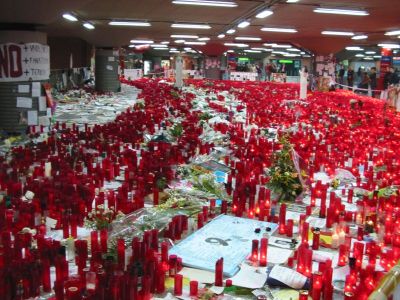
In Memoriam

Somehow it suddenly came to mind that today is the fifth anniversary of the Madrid train bombings.

Friday, March 06, 2009

Slowly into Atonia

Haydn was excellent. Shostakovich was comprehensible. Schnittke was just ... strange. It had hints of atonalism, but just when they started to really show the old tonal system comes back ... with some minor distortions. The strings in a strange dissonance, trying to 'explore the difference between C-sharp and D-flat'. It can almost stand as its own idiom of sound, actually. Tonal and atonal and semi-tonal in quick succession, all at once ... polystylic, indeed.
Also, there seemed to be very few people in the audience with Singaporean accents. Quite sad, really.

Three Poems

m&ms

me mumbling mama
music to her ears
first child first words
mamas make believe
first mumbles are their names
maybes mostly missing
meaning mostly masked
mumbling morphing into mumurs
me discovers magic
first book first words
mess of marks that manage meaning
mystery making sense
magic making way for
matter mass and molecules
maddening mathematics
morebooks more words
magic mostly missing
meaning mostly masked
mighty man to meek mouse
mumbling marriage vows
modals may I might I
middle spreading ageing
muttering magic spells
mystery mostly missing
meaning mostly masked.

Last book last words,
the mask falls away.

Feathers

Show your colours,
fly united.

Feathers are passports
to a community;
acceptance and strength in numbers,
but only if you have feathers
of the same colour
the same texture
the same quality
of the flock you want to
fly and roost with.
But if your feathers are
marked
spotted
damned
with patterns no flock
seems to understand
or want;
if everyone is in shades of paradise
and you are the only one in
colour of the
fields
woods
mountains --

But feathers are instruments of flight,
travelling clothes
for running light and warm;
feathers not to join
but escape from
sameness
conformity
flockishness of safety in numbers;
feathers to set you apart and be your mark
of courage
as you turn
into the wind
and soar.

Show your colours,
fly solo.

The Brave Heart Opens

The brave heart opens; the frightened one
stays closed, afraid to upset the
balance the head is used to.

The brave heart opens; to life
and living to death and dying, knowing
yet not fearing.

The brave heart opens; to love
in giving and taking, to holding
and losing, fearing yet still loving.

The brave heart opens; to parents
friends and teachers, seeking to be
with, yet never afraid to be without.

The brave heart opens; to God
if He is there, hoping that He is,
but not fearing if He isn't.

- Colin Cheong

The Listeners

‘Is there anybody there?’ said the Traveller,
Knocking on the moonlit door;
And his horse in the silence champed the grasses
Of the forest’s ferny floor:
And a bird flew up out of the turret,
Above the Traveller’s head:
And he smote upon the door again a second time;
‘Is there anybody there?’ he said.
But no one descended to the Traveller;
No head from the leaf-fringed sill
Leaned over and looked into his grey eyes,
Where he stood perplexed and still.
But only a host of phantom listeners
That dwelt in the lone house then
Stood listening in the quiet of the moonlight
To that voice from the world of men:
Stood thronging the faint moonbeams on the dark stair,
That goes down to the empty hall,
Hearkening in an air stirred and shaken
By the lonely Traveller’s call.
And he felt in his heart their strangeness,
Their stillness answering his cry,
While his horse moved, cropping the dark turf,
’Neath the starred and leafy sky;
For he suddenly smote on the door, even
Louder, and lifted his head:—
‘Tell them I came, and no one answered,
That I kept my word,’ he said.
Never the least stir made the listeners,
Though every word he spake
Fell echoing through the shadowiness of the still house
From the one man left awake:
Ay, they heard his foot upon the stirrup,
And the sound of iron on stone,
And how the silence surged softly backward,
When the plunging hoofs were gone.

-- Walter De La Mare

Monday, March 02, 2009

Ruminate

Has your pet squirrel been chewing the trees lately?
(Botany) Presenting a chewed appearance; permeated by striæ; striated, marbled.

Inform

Did you know it could be an adjective as well? Then it is read as in- + form: Not endowed with form, nebulous and formless.
'The budding of the seed, the change of wind, / The inform steps of age ...'

几何与想像

不久前在网上找到一套标题为《几何与想像》的教学材料,这几天刚开始看仔细看。这套教材相当有趣,它是由四名很有成就的几何学家编的(其中包括约翰 · 康威和威廉 · 瑟斯顿),用于明尼苏达州立大学的几何中心开办的一门课程。课程标题同样为《几何与想像》,名副其实,它的主要目的在于启发与提升学生、读者在几何方面的想像能力,让他们从而对各种几何形状与几何概念获得更深、更全面、更扎实的了解。
例如教材前面部分有一系列关于正多面方体(即柏拉图立体)的问题。让正四面体竖立在一个顶点上,其最高点与最底点半当中的横截面回呈现什么样的形状?让正八面体卧在一面上,同样的横截面又会呈现什么形状?在正十二面体的二十条边上行驶,能否找出一条路,让我们从一个顶点开始,当中没有重复地探访所有其他顶点,最后回到我们原来开始的顶点?若是二十面体呢,我们能从它的三十条边中拼出这样的一条路吗?
思考着这些问题时,我对这些立体奇特的素质有了深深的体会。Their symmetry is truly startling. The same number of edges and faces meet at any one vertex, at the same angles. Each of the Platonic solids thus looks exactly the same from any one of its vertices, or from any one of its edges, even the icosahedron with its thirty edges and twelve vertices. There isn't only symmetry in each of them, there's symmetry among the five of them: the dodecahedron has twelve faces and twenty vertices, the icosahedron twenty aces and twelve vertices, and both have thirty edges. Their graphs are dual. Same for the octahedron and the cube ... and the tetrahedron is its own dual. When such symmetry as such, in dry, compact words, it is merely an interesting fact. When one discovers it for himself (or herself) in the process of visualising, realising these solids in the mind's eye, it becomes an source of sheer wonder.
在这以前两个星期还在做竞赛题目,做到头昏脑胀还做不出。通常思考到后来就开始思路模糊不清,已经被发现行不通的旧思路反复地在脑子里转,新思路怎样也想不出。归根结底,大概是因为不完全理解而缺乏想像力。不了解题目的根本,没有想像力得出新的思路,结果一直钻牛角尖,捉不住解题的关键。
在这样的情况下,预期继续闷头死做题目,远远不如通过类似与《几何与想像》的教材来培养想像力与数学直觉。

Saturday, February 28, 2009

'Oh, it'll be fun.'

'It is recognised, Lawrence, that you have a funny sense of fun.'

Sunday, February 22, 2009

Vindication of Title

As anyone who has ever taken the time to look at one of nature's fine works might have suspected, all trees really are graceful. This means that, among other things such as olive trees, firecrackers and caterpillars, all lobsters are indeed graceful. It also this page should no longer be there. Well done, Gilbert.

Edit: The post might have been a little premature because the proof really seems quite sloppy.

耐心

你需要的是耐心。耐心地慢慢积累,耐心地等待时机。不能因为眼前没有成绩而气馁。你需要的是专心,不能因为心急着要办成一件事而把所有其他事都置之不理。做事要稳妥,从容;做人也要如此。

Possibility C

Maybe you just suck at it, in which case you should start looking at alternative futures right now. Oh dear.

Ardent

" ... desde el salar, ardiente y mineral ... "
Positively burning with passion.

Saturday, February 21, 2009

三十年河东,三十年河西

'Up to the late 1960s, Cambodia was the shining star of Indo-China, a confluence of intellectuals, traders, artists and bourgeois who lived, played and worked there. Phnom Penh was the jewel of Asia then. Lee Kuan Yew, the first Prime Minister of Singapore visited Cambodia in April 1967 at the invitation of Prince Norodom Sihanouk. Cruising along the capital's elegant boulevards in a Mercedes convertible, Lee turned to his host and said, "I hope, one day, my city will look like this".'
Perhaps it was telling that Harry chose the verb "look" instead of "be"?

Friday, February 20, 2009

Engmalchin

'A Malayan language will arise out of the contributions these communities will make to the linguistic meltingpot. The emerging language will then have to wait for a literary genius who will give it a voice and a soul, a service which Dante performed for the Italian language.'
But the supposedly disparate tongues whose agglutination Dante sparked to form the Italian vernacular were rather closely related in the first place -- no more, really, than dissimilar dialects. To hope for something similar with such a diverse group of languages, with different roots, different histories, different syntaxes, even different writing systems, is rather a stretch. Maybe, just maybe, it will happen one day. But not, I dare say, anytime in the foreseeable future.

A Depressing Thought

'While in other countries, political parties come and go, but the country remains the rallying point for the people’s feelings, in Singapore, the Government has become synonymous with the country. Indeed, Singapore is often seen as the creation of the PAP, made to its image and likeness. Hence, dislike of the PAP, even though it does not translate into dislike of Singapore, effectively blocks out any spontaneous outpouring of patriotic emotion. ...If loyalty towards the country is blocked, it has to be directed elsewhere. In Singapore, it is directed at the good life which the country has come to represent. ... There is by now an almost adulatory quality about the attachment of Singaporeans to the affluence which their parents never knew and which came their way so quickly. ... This kind of loyalty is, of course meretricious. It changes with its object. Hence, when the good life diminishes, so will it. When the good life disappears, so may it. But the most insidious aspect is its mobility. It will uproot and move with the good life. Hence, if economic prosperity is no longer in Singapore but moves to Canada, Australia, the United States, China, it will re-locate itself accordingly. ... Such a volatile, mobile loyalty is of course a travesty of the patriotism it has displaced and a mockery of all the earnest effort that the Government and the people have put into the building of the country over three decades.

Even if such a sinister scenario does not arise, a growing emotive estrangement between the Government and the people is not a healthy thing. It could create a schizoid society where head is divorced from heart, where there is a double agenda and double book-keeping with people agreeing with the Government in public but saying something else in private.' - The PAP and the people - A Great Affective Divide (1994). (It really is a discredit to the Gahmen that they had to employ their sledgehammers and pound the table instead of delivering a similarly eloquent riposte.)

...

'If there are passionate Singaporeans working in Singapore, I have yet to meet them.'

Have we really all turned into a bunch of money-grubbers with no ideals whatsoever?

Section View of Snowstorm (selected details)

Supposedly when the sub-prime mortagage crisis hit America, entire swathes of less-glitzy suburbs emptied out and turned into vacant shells, as their bankrupt residents simply left with their meagre belongings before the bank came to repossess their houses. A somewhat even more surreal version of this is happening in Dubai. Dubai has been going quite crazy lately ... sort of like Singapore on steroids and with far more impulsive planning. Perhaps the crunch, now that it has come, will drive them far crazier too.
On the somewhat brighter side, some firms are still not in a "just retrench" mood. I don't know how true Toyota's sentiment that simply shedding 10 per cent of its North American work force would be a disaster' because '"if respect for people goes out the window, then they lose the foundation for the future because then suddenly people are going to say this company is not any different from any other company."' So what if propsective employees don't discern between Toyota, Nissan and GM? As long as they are willing to work at any one of those firms, isn't it all the same for the employers? But maybe benefits do accrue to Toyota due to employee loyalty. It would be interesting to find out, in an objective, rigorous way, for sure. Either way, it is a heartening thing to know that cold, hard capitalism isn't all there is in this world.

Szym

One day, I will learn Polish, so that I can read Wisława Szymborska's works untranslated. And master all of Szymanowski's piano sonatas. Or maybe you are only experiencing a strange, passing fixation with that consonant group at the moment.

Saturday, February 14, 2009

Metaphor of Purpose

I should be a candle, shining with a warm brilliance so that I may illuminate those around me.
It sounds awfully trite, and there will be no doubt many, many occasions when I would simply fail to live up to it, but let it stand as a reminder of my life's purpose.

Proactivity

On the second day of Exercise Warrior, when we were on our way to the platoon ambush site in the rain which had been going on since forever, this guy with two plum blossoms on his epaulette and a red beret came up and started talking to the GPMG team. (Or maybe he didn't have his red beret then, but for some reason in my memory his red beret was an inseparable part of him, whatever the rest of his attire.) 'Hi ... what do you think is the MG commander's job? ... It's to look for a job to do. You should never be waiting around doing nothing ... go and find an arc of fire to cover, run somewhere and deploy your guys ...' And then he went off to talk to the trainee platoon sergeant.
Then the only response we could muster, being handicapped by thoroughly soaked attire and a full combat load, was "okay, so it's true that the higher your rank, the more you talk." Now, his comments start to make rather more sense. The MG is a powerful asset, and the commander should be constantly trying to maximise its effect, to get it to work for the rest of the platoon, so that life is made that little bit easier for the whole platoon.

Friday, February 13, 2009

A Hierarchy of Power

Chekhov's "The Princess" left a strong impression in my mind that stayed for days, and its tirade against hypocrisy is still embedded deep inside today. The stories from Wena Poon's superb collection "Lions in Winter" resonated deeply when I read them, and still leave residue impressions, but these are somewhat less clearly-defined than that left by the Chekhov. By comparison, Effie Chuang's short stories are interesting, particularly "The Gulag" and "Bravado", but nowhere as powerful.
Whence the difference? Is it in the wealth of detail that bring the stories to life, that flesh out the characters and make them more than just abstract conceptions in the author's mind? ('The good writers touch life often. The mediocre ones run a quick hand over her. The bad ones rape her and leave her for the flies.') Is it just a matter of resonance, that I as a reader am more receptive to and remember more deeply certain stories and messages? Or probably some combination of both.

Post-Admin

'Until quite recently, then, the American military Services have been inclined to consider post-conflict operations not as a part of war itself, but as something belonging to its aftermath—a view that has obscured “the fact that the principal condition for strategic success in the wars in Afghanistan and Iraq was the establishment of a political (and to a certain extent an economic) order favorable to the United States.”'
Echoing, on a larger scale, Staff Alan's remark to the effect that the exercise isn't over until the post-admin is complete.

Next

'Next, a range of advances in the cognitive sciences, biotechnology, medicine, and nanotechnology appear to be converging toward giving humans heretofore unprecedented capabilities to modify or enhance the physical, cognitive, and socio-emotional performance of individuals. Possibilities range from giving combatants pharmaceuticals to resist fatigue or function longer without sleep to accelerating muscle growth or cell strength with temporary or permanent genetic modifications, to improved human-machines interfaces, to better predictive methods for assigning individuals to the combat roles for which they are best suited. By way of illustrating that such things are already here, the drug Ritalin not only improves the academic performance of hyperactive children, it can also do the same for normal children. Ritalin is “commonly thought to boost SAT scores by more than 100 points.”'
(Adam Russell and Bartlett Bulkley, Human Performance Modification Primer (Herndon, VA: Scitor Corporation, January 2007), FOUO (For Official Use Only), pp. 1–5, 9–13.
Michael S. Gazzaniga, “Smarter on Drugs,” Scientific American Mind, September 2005, pp. 33–34.)

Science and technology really seem to have a way of sneaking up on you while you aren't watching.

Monday, February 09, 2009

Am I still attached to Shanghai?

Not really. Come to think of it, I do not have the same sense of attachment to any one place that some people show so strongly. All my relatives are there. Most of my friends are here. My childhood memories are scattered over three places eleven thousand kilometres apart. Certainly many precious memories are linked to this Most Serene city-republic. But I wouldn't feel as sorry or sad to leave, whether for a year or a decade, as you seemed to be yesterday. When I fly between Singapore and China -- and this is the one thing I would miss most, really, when I finally change citizenship -- the immigration counters welcome me home on both sides. I feel slightly sad at not being able to enjoy the same welcome on both ends any more ... but in an objective analysis, of what importance is such a trivial matter of appearances? At heart, nothing has changed. My home is everywhere and nowhere. It is not a place, but the company of your family, of your good friends, the warm fuzz of memories.

A touch of magic

That one passage near the end of Chopin's "Konrad Wallenrod" Ballade didn't quite come through, but still yesterday's recital was very, very good. Haydn came through with a nice mix of reserve and emotion. Bach-Busoni's Chaconne was thoroughly engaging and powerful ... although rather more Busoni than Bach at some points. It reminded me a bit of Godowsky's Passacaglia actually. Similar in form, similar in spirit. Chopin's four Ballades were nicely executed ... with some minor slips, but then again they are difficult. The second left the most vivid impression ... the profoundly calm andantino and the calamitous storm of an interruption. And the three Chinese pieces, like crowning jewels, small episodes in comparison to the long narratives of the other pieces but sparkling in a clear and unique light.
And to think the pianist was only 22. Amazing.

Phantasmagoria

An allegory of illusions; a product of dreams or fever. Maybe the two are not so different, are they.

LOL

This thing is quite like Ravel's Boléro, actually ... except less refined.

Wednesday, February 04, 2009

A touch of Québec

You have violated your own language laws. You are hereby fined a pitiful amount of dough and given a stiff but suitably stern formal warning.

Sunday, January 25, 2009

Catatonia

I never knew it was possible for the mind to be so blank. Terrifying.

Saturday, January 24, 2009

The Impressionistic Novel

I used to baffle at the great amount of precise detail that would appear in the middle of Homer's sagas or Hugo's huge novels, details about each of the individual warriors of the Myceneans fighting against Illium, or about each skirmish in the Vendée in 1793. The level of detail seemed tedious and quite unnecessary to the plot.
Then I realised it would seem less incomprehensible if one considered the realist style of paintings popular from the Renaissance till the nineteenth century or so. They also exhibited a great variety and level of detail; this did not however hinder their existence as artworks, with a message and value which emerged out of, or existed alongside, all that detail. Similarly for the Odyssey, Illiad, Les Misérables, or even Georges Perec's La vie: mode de emploi; their message is carried alongside their wealth of detail.
Novels which do not have so much detail, on the other hand, are more like Impressionist works: they portray the scene in a more idiosyncratic way, playing with the light, highlighting certain details and eliding over others.

Saturday, January 03, 2009

Quite Cool


'De Bruijn graphs are ideal for people who are easily lost. No matter where you happen to be in a de Bruijn graph you can always get to your home node, whatever it might be, by calling its name. From whatever node you find yourself at, just follow the path whose label is the name of the node you wish to find and it will take you there, as if by magic.'