'Simply sit back and twiddle your thumbs as, completely by chance, all 200,000,000,000,000,000,000,000,000,000,000,000,000,000,000,000,000 atoms making up the planet Earth suddenly, simultaneously and spontaneously cease to exist.' -- No. 10 from "Top 10 Ways to Destroy Earth"
And the best part is that it's entirely possible (although not at all very likely).
In other news, black holes from the LHC are not about to destroy the Earth yet. Doomsayers, look elsewhere.
Monday, October 27, 2008

Sunday, October 26, 2008
Highlights from South Beach
A rather late update on one of the venues of the the Singapore Biennale 2008.
 This wasn't the most interesting work on site, but it was pretty visualy striking.
The most interesting works on site were video installations: two which were really documentaries and another which addressed the finer points of reality on film and was irreverently self-referential in the spirit of Hofstadter's Gödel, Escher, Bach. Perhaps documentaries could be considered art too, if one considers the primary purpose of art to be communication about the human condition.
There was also a barbershop, no, a pair of barbershops set up to be exact mirrors of each other, and a mixed-media installation involving a luminous acrylic crescent moon.
 If I put up a similar wall for every novel I found interesting and wanted more people to know about, Singapore would be full of concrete slabs proclaiming various contemporary translated titles. That would be ... mildly surreal. Anyway, if you see the BG in the bottom left-hand corner of that picture somewhere around early October, do wish her a Happy Birthday. Hehe.
 Another relatively visually striking work. This temple made entirely out of sugar had rather decayed by the time we saw it ...
 At times it seemed that the architecture itself, still exuding an air of abandoned desolation, was more appealing than the exhibits. The exhibits were, on the whole, not terribly good. Too many of them were absolutely baffling before they were explained in words; then they became just baffling in the usual manner. If the purpose of art is to communicate, then we should consider these artworks to have failed.
But hey, the company was wonderful. So it wasn't really a waste of time.
 This wasn't the most interesting work on site, but it was pretty visualy striking.
The most interesting works on site were video installations: two which were really documentaries and another which addressed the finer points of reality on film and was irreverently self-referential in the spirit of Hofstadter's Gödel, Escher, Bach. Perhaps documentaries could be considered art too, if one considers the primary purpose of art to be communication about the human condition.
There was also a barbershop, no, a pair of barbershops set up to be exact mirrors of each other, and a mixed-media installation involving a luminous acrylic crescent moon.
 If I put up a similar wall for every novel I found interesting and wanted more people to know about, Singapore would be full of concrete slabs proclaiming various contemporary translated titles. That would be ... mildly surreal. Anyway, if you see the BG in the bottom left-hand corner of that picture somewhere around early October, do wish her a Happy Birthday. Hehe.
 Another relatively visually striking work. This temple made entirely out of sugar had rather decayed by the time we saw it ...
 At times it seemed that the architecture itself, still exuding an air of abandoned desolation, was more appealing than the exhibits. The exhibits were, on the whole, not terribly good. Too many of them were absolutely baffling before they were explained in words; then they became just baffling in the usual manner. If the purpose of art is to communicate, then we should consider these artworks to have failed.
But hey, the company was wonderful. So it wasn't really a waste of time.
Convergence, Buenos Aires
 Doesn't it vaguely remind you of those patterns formed by iron fillings responding to magnets?
Presenting The Tiong
The epitome of relaxed. You thought you were relaxed? Evidently you haven't seen The Tiong yet. He's very relaxed. Relaxed enough to sit intently in front of the computer during his shift as DOS, fully engaged in ... playing Bloons. In his admin attire, with boots by the side. You want to be more relaxed than that? It'll be hard.
Monday, October 20, 2008
Let us all remain Zen.
Life will kill you. Suck it up.
(JT: Another thing I’ve found is that many children have a surprising thing happen while they’re sucking it up in that class that they hate. They actually come to enjoy it. Has that ever happened to you?
Students: Yeah. [with a glint of self-realization])
Glen Gould's interpretations of the pieces in Bach's Well-Tempered Clavier are becoming more and more compelling. They are starting to glow subtlely and to speak in their varied but always clear and calm voices. Sublime.
(JT: Another thing I’ve found is that many children have a surprising thing happen while they’re sucking it up in that class that they hate. They actually come to enjoy it. Has that ever happened to you?
Students: Yeah. [with a glint of self-realization])
Glen Gould's interpretations of the pieces in Bach's Well-Tempered Clavier are becoming more and more compelling. They are starting to glow subtlely and to speak in their varied but always clear and calm voices. Sublime.
Beyond bizarre, once again.
No one ever said modern architecture was going to be bland. But some of the 2010 World Expo pavilions (if you don't read Chinese, now is a good time to start. Hint hint :P) are really quite far off to the other extreme ... the English one, for instance, looks like a piece of giant rainbow toffee candy.


Sunday, October 19, 2008
Imperfection (II)
Let me refine what I said previously. It is not, primarily, our strengths that make us human, that colour and give character to our lives, but our weaknesses, contradictions and idiosyncrasies. Perfection is nice and boring, something we could leave to machines. Imperfection is much more human.
When we celebrate great human achievements--be it the first human landing on the moon, Liu Xiang's record-breaking 110m hurdles timing, or a perfectly-mixed cocktail, we are celebrating not so much strength in itself, as the overcoming of weakness, the struggle towards perfection.
When we celebrate great human achievements--be it the first human landing on the moon, Liu Xiang's record-breaking 110m hurdles timing, or a perfectly-mixed cocktail, we are celebrating not so much strength in itself, as the overcoming of weakness, the struggle towards perfection.
This is Home, truly ...
All quotes from Hong Xinyi, "Home is a City to Love," Straits Times 10 October 2008: A33.
'Personally, I like eternal cities: not ones that are frozen in time, but ones where changes are firmly rooted in the city's own traditions and idiosyncrasies, with identities beyond the vagaries of what hip jet-setters consider cool at any particular moment.
As for a home that morphs from casino kingdom to race circuit to aviation playground to marina central with the influx of each new tide of revellers -- it seems to me that such a city, hollowed out for easy access to shallow new identities, will be very difficult to love.'
'But it would be nice, after months of hearing about expensive race cars and visiting celebrities, to revisit the notion that this is not just a place that hosts events.'
'"They're not building things that will become places people care about ... Home is wherever you want it to be."'
Where's the common thread? Perhaps it's that home is a subjective construct, built by each individual out of an intensely personal collection of memories. No amount of marketing and propaganda can create or induce a sense of one. Maybe that's what people mean when they say that Singapore is not a good home because it lacks a "soul": that they do not have so many memories invested here, or the bits that tie them down here have been swept away, renovated, redeveloped, repackaged into something completely unfamiliar.
'Personally, I like eternal cities: not ones that are frozen in time, but ones where changes are firmly rooted in the city's own traditions and idiosyncrasies, with identities beyond the vagaries of what hip jet-setters consider cool at any particular moment.
As for a home that morphs from casino kingdom to race circuit to aviation playground to marina central with the influx of each new tide of revellers -- it seems to me that such a city, hollowed out for easy access to shallow new identities, will be very difficult to love.'
'But it would be nice, after months of hearing about expensive race cars and visiting celebrities, to revisit the notion that this is not just a place that hosts events.'
'"They're not building things that will become places people care about ... Home is wherever you want it to be."'
Where's the common thread? Perhaps it's that home is a subjective construct, built by each individual out of an intensely personal collection of memories. No amount of marketing and propaganda can create or induce a sense of one. Maybe that's what people mean when they say that Singapore is not a good home because it lacks a "soul": that they do not have so many memories invested here, or the bits that tie them down here have been swept away, renovated, redeveloped, repackaged into something completely unfamiliar.
387 more days to ORD
Sunday, October 19 2008. 1422. Fair, slightly overcast.
What a week.
On Thursday, I finally managed to convince myself I am not hopeless at shooting. Which, incidentally, means that my No. 4 just became a little bit less plain. The joy.
The day after that, there was a big conflagration. Oh well. It was all a misunderstanding. Really, it was. Why does someone have to take the blame? (Although, in the end, after a slightly nasty argument, no one really did) Isn't it altogether better to forget the whole blame business and focus on trying to prevent it from happening again? Yes, what happened that morning was not very nice. And all involved should take responsibility. But it is a plainly stupid and primitive view that equates 'take responsibility' with 'sign extras'. I fully agree that I am partly to blame for what happened. But I do not see how this justifies three extras (and none to anyone else involved) and would have refused to sign without raising hell over it first. Extras for permstaff are used far too liberally here. As is PT for recruits. The bottom line is, fear and other negative emotions are more efficient way of producing conformity. Not a nice thing to realise, but maybe that's the way the truth usually is.
After that Syukri and Hashim came to tell me that I was being 'too soft on the recruits.' Probably true. Hmm. I am becoming the mirror image of Sergeant Huang. Maybe eventually I will attain de facto permanent COS position, too. A terrible thought.
But I guess they were right ... I should become more demanding. Stricter but not necessarily fiercer. Surely there must be some way to pull this off without liberally meting out push-ups ... we shall see. Next week is supposed to be hell week, after all the specialists raised a ruckus with OC this Friday and asked for more freedom to discipline their platoons. And IFC lessons are starting too. After that there's field camp. So, in some sense, the next two weeks and a bit are supposed to be the toughest and most memorable part of BMT. Less, of course, 24-klick. How will the recruits come out of it? And how well will you do as instructor? We shall see ...
What do I remember vividly so far, in my own NS? Sitting at the back of the Cougar lecture room, not being able to hear much, listening to Xiaowen counting down the time to the first bookout in minutes. The admonishment Lieutenant Na gave me over losing my status slip: "Soldiers aren't supposed to be like that." Being the last man to finish the SOC rundown, with all the instructors running behind me in a huge, noisy cloud ("Hurry up! Go! @#$%^&*!"). And then, in SISPEC, once again the sensation of exhaustion after every SOC rundown, the Strength Training sessions involving never-ending static exercises and Sergeant Tay going "Don't believe him. This PTI is a liar!" while doing the push-ups with us, the long overnight marches during Grandslam 2, and then finally the time I fell out of Warrior, with all the instructors shouting at me. And, strangely, ASLC dispersal. I don't really remember all the times we were tekaned. The concrete memory fades, leaving only the memory of the fact ("yes, we did do a lot of push-ups" or "yes, we were made to leopard crawl through the mud"). Tekan is unpleasant and of no value in itself, so the mind relegates it to the far reaches of memory, leaving it to be eroded by the sands of time, hopefully leaving the lessons learnt. I don't remember most of the long route marches either; they are now only faint memories. What I remember is the sense of great physical challenge or occasions when others' words struck a deep chord.
In other news, I'll be exactly halfway through NS when my current batch of recruits complete their BMT. Whoo.
[654]
What a week.
On Thursday, I finally managed to convince myself I am not hopeless at shooting. Which, incidentally, means that my No. 4 just became a little bit less plain. The joy.
The day after that, there was a big conflagration. Oh well. It was all a misunderstanding. Really, it was. Why does someone have to take the blame? (Although, in the end, after a slightly nasty argument, no one really did) Isn't it altogether better to forget the whole blame business and focus on trying to prevent it from happening again? Yes, what happened that morning was not very nice. And all involved should take responsibility. But it is a plainly stupid and primitive view that equates 'take responsibility' with 'sign extras'. I fully agree that I am partly to blame for what happened. But I do not see how this justifies three extras (and none to anyone else involved) and would have refused to sign without raising hell over it first. Extras for permstaff are used far too liberally here. As is PT for recruits. The bottom line is, fear and other negative emotions are more efficient way of producing conformity. Not a nice thing to realise, but maybe that's the way the truth usually is.
After that Syukri and Hashim came to tell me that I was being 'too soft on the recruits.' Probably true. Hmm. I am becoming the mirror image of Sergeant Huang. Maybe eventually I will attain de facto permanent COS position, too. A terrible thought.
But I guess they were right ... I should become more demanding. Stricter but not necessarily fiercer. Surely there must be some way to pull this off without liberally meting out push-ups ... we shall see. Next week is supposed to be hell week, after all the specialists raised a ruckus with OC this Friday and asked for more freedom to discipline their platoons. And IFC lessons are starting too. After that there's field camp. So, in some sense, the next two weeks and a bit are supposed to be the toughest and most memorable part of BMT. Less, of course, 24-klick. How will the recruits come out of it? And how well will you do as instructor? We shall see ...
What do I remember vividly so far, in my own NS? Sitting at the back of the Cougar lecture room, not being able to hear much, listening to Xiaowen counting down the time to the first bookout in minutes. The admonishment Lieutenant Na gave me over losing my status slip: "Soldiers aren't supposed to be like that." Being the last man to finish the SOC rundown, with all the instructors running behind me in a huge, noisy cloud ("Hurry up! Go! @#$%^&*!"). And then, in SISPEC, once again the sensation of exhaustion after every SOC rundown, the Strength Training sessions involving never-ending static exercises and Sergeant Tay going "Don't believe him. This PTI is a liar!" while doing the push-ups with us, the long overnight marches during Grandslam 2, and then finally the time I fell out of Warrior, with all the instructors shouting at me. And, strangely, ASLC dispersal. I don't really remember all the times we were tekaned. The concrete memory fades, leaving only the memory of the fact ("yes, we did do a lot of push-ups" or "yes, we were made to leopard crawl through the mud"). Tekan is unpleasant and of no value in itself, so the mind relegates it to the far reaches of memory, leaving it to be eroded by the sands of time, hopefully leaving the lessons learnt. I don't remember most of the long route marches either; they are now only faint memories. What I remember is the sense of great physical challenge or occasions when others' words struck a deep chord.
In other news, I'll be exactly halfway through NS when my current batch of recruits complete their BMT. Whoo.
[654]
Sunday, October 12, 2008
Macrovision
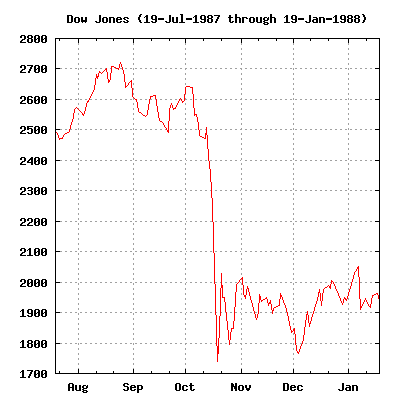
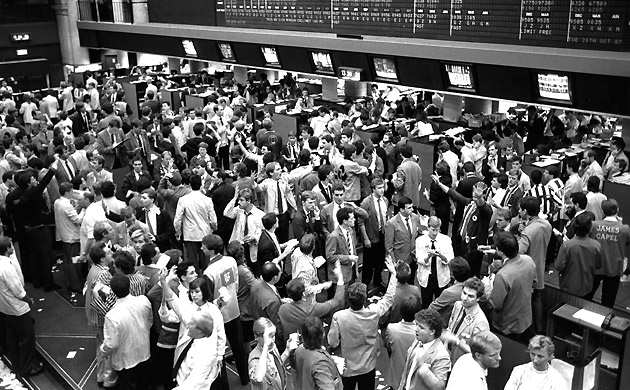 Is that 2008? No, it's 1987. And then, after that, 1998. People, the media especially, are fond of the word "unprecedented". Sure, the current financial crisis is in some ways unique, in some aspects truly different from what had happened before. But it is definitely not the first time that loss of confidence, market panic and loss of liquidity has happened on a mass scale in the economies of the world. Grand old investment banks may collapse, some markets may be nationalised, the financial system might come out looking completely different---but, at the end of the day, life goes on. Deeper shit has happened before, and the world has come out of it alive and, eventually, well. Alarmist rhetoric along the lines of 'we may not have an economy on Monday' is quite uncalled for.
Eric Hobsbawm noted, 12 years ago in the preface to The Age of Extremes, how people today no longer have a sense of the past. Seeing how so many are running around "stunned", "surprised" and "shocked" about the current crisis, as if nothing like it had happened before, surely vindicates his argument that we are sorely in need of a sense of historical perspective.
And that, by the way, was the hundredth post.
Mission Statement
I will expand the realm and widen the horizons of human possibility. I may help individuals do that, by helping them see new perspectives, achieve new vistas, attain the dazzling heights of their potentials; or, if I can, humanity as a whole, by building on and further creating human knowledge, by bringing fresh and illuminating perspectives to bear on the existing.
To do so, you will need to expand your own horizons as far as possible first, in every sense of that word. You should learn as many sciences and arts and skills as you can, and read and travel widely. Talk to people, no matter how different, and try your best to communicate and connect with them. Then build on these. Push a bit further, and glimpse just beyond the current limits of the horizon. Tell others just how wide their horizons could be.
I am not a hedonist in any sense of the word. I do not crave material enjoyment for its own sake, nor will I hoard present knowledge for the sake of merely appreciating it without further building on it.
So. That was a lot of big, fluffy words. What concrete thing are you doing today to work towards your mission?
To do so, you will need to expand your own horizons as far as possible first, in every sense of that word. You should learn as many sciences and arts and skills as you can, and read and travel widely. Talk to people, no matter how different, and try your best to communicate and connect with them. Then build on these. Push a bit further, and glimpse just beyond the current limits of the horizon. Tell others just how wide their horizons could be.
I am not a hedonist in any sense of the word. I do not crave material enjoyment for its own sake, nor will I hoard present knowledge for the sake of merely appreciating it without further building on it.
So. That was a lot of big, fluffy words. What concrete thing are you doing today to work towards your mission?
Hypocrisy, or variation on Edmund Burke
(Notwithstanding the fact that the quote I'm about to attribute to him might not actually have been something he said)
Hypocrisy is a product of laziness, not a deliberate choice. People don't choose to be hypocritical; they're only too lazy to hold themselves to the same exacting standards as they demand of others. Or they adhere to fashionable or orthodox viewpoints, and conveniently neglect to sort out the troublesome conflicts between those viewpoints and their own beliefs and actions.
Hypocrisy is a disgusting creature. But it may be an altogether accidental one.
Burke (may or may not have) told us that, "The only thing necessary for the triumph of evil, is for good men to do nothing." Now it seems that the only thing necessary for one to be evil is for one not to do anything to be good.
Hypocrisy is a product of laziness, not a deliberate choice. People don't choose to be hypocritical; they're only too lazy to hold themselves to the same exacting standards as they demand of others. Or they adhere to fashionable or orthodox viewpoints, and conveniently neglect to sort out the troublesome conflicts between those viewpoints and their own beliefs and actions.
Hypocrisy is a disgusting creature. But it may be an altogether accidental one.
Burke (may or may not have) told us that, "The only thing necessary for the triumph of evil, is for good men to do nothing." Now it seems that the only thing necessary for one to be evil is for one not to do anything to be good.
Subscribe to This V3R or Carry On Twenty
V3R here referring not to the Motorola RAZR phone, but to "shared Vision, Rules, Roles and Relationships"---the tenets of the SAF's supposed team-building model. Every NSF in the Army now would have gone through at least two sessions in which their section / platoon / syndicate would be asked to sit around and discuss their vision for the course / posting and set down rules, describe roles and decide how they wanted their relationships to be, in order to achieve that vision. On paper, that is a Very Good Idea. Discussion produces synthesis, produces agreement, promotes participation and involvement. But it never quite works out. The "shared vision" usually ends up as a bland, unwieldy pastiche of generic, undescriptive homilies. Something that people would hesitate to believe in whole-heartedly even if they wanted to. The rules and roles are glossed over briefly, and a less unwieldy but no less bland homily stands in to describe the rules of conduct for "relationships". Hardly anyone is willing to put in the necessary effort needed to produce genuine synthesis, consensus and agreement. Instead, the participants invariably agree to cut short the session so that everyone can go for lunch, and acquiesce in the first semblance of a compromise that can be formulated. More time is needed, if it is really to be a Very Good Idea.
How many people really do partake in a Shared Vision, at the end of this somewhat farcical process? Not many, surely. And if that is the answer, how can the description, "Shared Vision", still stand, when it is only shared by so few of the people it should be shared amongst?
This isn't just a problem that presents itself in the narrow circle of Singaporean NSFs. Humankind could achieve so much if it were united in purpose---but, of course, we are not. We are all individuals with our own individual dreams and purposes, and these will invariably clash at times. And compromise and true alignment of purpose takes time and effort---plenty of both. Which means, considering how stingy people usually are with either of those, it doesn't happen.
Where shared intent fails, there arise incentive structures. That's why incentive structures pop up everywhere in human society---because shared intent fails so often. Think of all the instances where incentive structures are inducing people to align their actions with others' vision and intents: push-ups for not following your platoon sergeant's injunction to move fast, or execution by hanging for drug trafficking, or a potential $5 gain for selling that book you're not going to read again to a willing buyer, even though you're not particularly into sharing books. The spirit of Adam Smith still trumps that of Marx at resource allocation any day.
How many people really do partake in a Shared Vision, at the end of this somewhat farcical process? Not many, surely. And if that is the answer, how can the description, "Shared Vision", still stand, when it is only shared by so few of the people it should be shared amongst?
This isn't just a problem that presents itself in the narrow circle of Singaporean NSFs. Humankind could achieve so much if it were united in purpose---but, of course, we are not. We are all individuals with our own individual dreams and purposes, and these will invariably clash at times. And compromise and true alignment of purpose takes time and effort---plenty of both. Which means, considering how stingy people usually are with either of those, it doesn't happen.
Where shared intent fails, there arise incentive structures. That's why incentive structures pop up everywhere in human society---because shared intent fails so often. Think of all the instances where incentive structures are inducing people to align their actions with others' vision and intents: push-ups for not following your platoon sergeant's injunction to move fast, or execution by hanging for drug trafficking, or a potential $5 gain for selling that book you're not going to read again to a willing buyer, even though you're not particularly into sharing books. The spirit of Adam Smith still trumps that of Marx at resource allocation any day.
State of (dis)orderliness.


Forecast for October to November: Generally much calmer. Mild to moderate fog. As before, occasionally sunny.
Friday, October 03, 2008
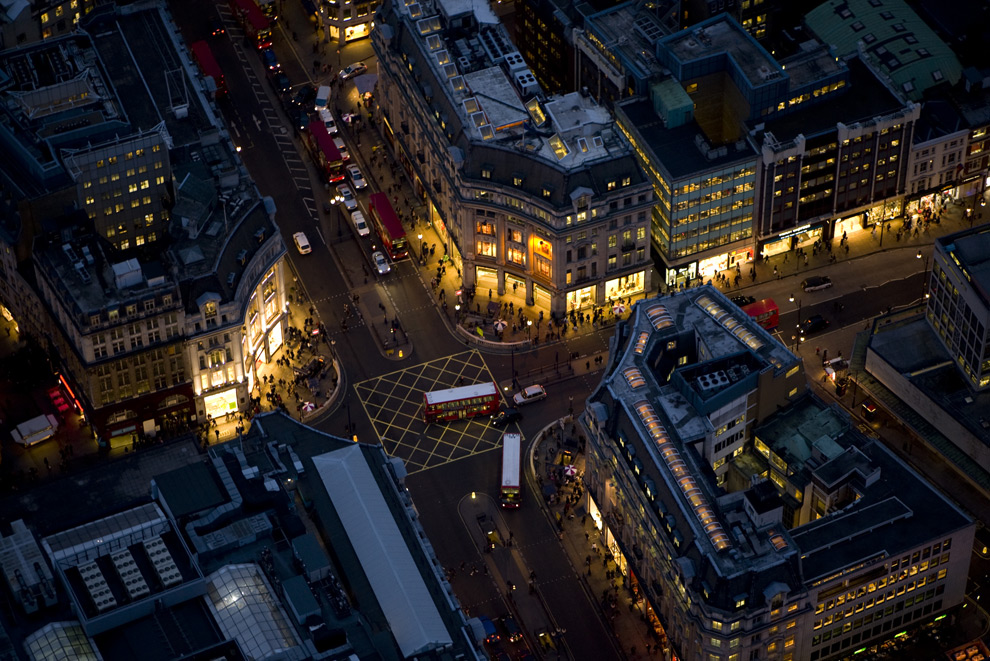
Wow. Unreal.
These photos of London really make the visual gap between real cities and SimCities just about close to zero. Just look at this photo of Oxford Circus ...

Subscribe to:
Posts (Atom)


