Showing posts with label Mathematics. Show all posts

Friday, August 11, 2017

A RAAG, an Anosov representation, and a Higgs bundle walk into a bar.

They start debating what GEAR could stand for. They immediately reject the notion that it could possibly stand for "Geometric structures and representation varieties", noting that this goes against everything that acronyms are supposed to do. After some back-and-forth the right-angled Artin group proposes that the acronym captures the way that the network functions: "Guesses, Errors And Retries". The Anosov representation and the Higgs bundle don't like this very much ... after more debate, the Anosov representation claims that the acronym is all about the guiding principle of the network: "Give Everybody Ample Renumeration". This is not universally accepted either, and the argument goes on ... finally, the Higgs bundle comes up with what is obviously the most perfect answer ... but nobody can understand a word of it.
(from Steve Bradlow, at the GEAR retreat banquet)

Tuesday, August 08, 2017

I am sorry for your loss.

I am sorry for our loss.
Let us do our best to honour her wonderful legacy.

Monday, November 07, 2016

Not actually the worst description of moduli spaces

"Yo dawg I heard you like geometry, so we put some geometry on your geometry, so you can geometry while you geometry."

Friday, October 21, 2016

Just one more thing now ...

Not too long ago the (apparently still English) current chair of the doctoral committee informed me that "now all that's left to do is to write and defend a thesis." That seems to have sparked a little bit of a dark mood in me. Now comes the part where you fall deep into a rabbit hole, for years and years on end, and never emerge, possibly not ever again, to see the broad sweep of the plains and the distant majesty of the mountains, is what some part of me seems to have heard.
But that was not what was said, and that is not what you should do. You should remember the way down the rabbit hole, the better to climb up back out of it. You should take note all of the tunnels that go between the rabbit holes, and the intricate networks that they form, and how they transverse the broad sweep of the plain and take you, sight unseen, towards the mountains. You should never forget, as you seem dimly aware of now, that the rabbit holes, for all of their fascinating depths, are only ever part of the story, and that you should never lose sight of the whole.
It will be a constant struggle to remember this, to remain as broad as you could be even as you delve deep into your chosen rabbit hole. But it's something that you can at least try to do, that you must at least try to do---and your work and life will be the richer for it.  

Monday, December 03, 2012

Sunday, March 25, 2012

Important Lessons in Life

The mean-value theorem doesn't apply to complex-valued functions.
You can't just discard summation signs, even when doing asymptotics.
If your blunt estimate didn't work, use more information!
You really didn't need to re-write that solution 8 times.
People take breaks for a reason, damnit.
Also, you should figure out what you're doing about Monday. Probably.

Wednesday, July 13, 2011

"Is there something you're trying to escape from?"

Yes. The frustration of drudgery. It's something we are all trying to escape from---why else would the concept of entertainment exist? But what if your escapade could shape the course of human experience---if not now or in the near future, then decades, even centuries into the future ... wouldn't that be something?
Not that that alone would have landed you anything, in all likelihood, but a lesson worth remembering: believe in what you say, and don't be afraid to give it straight.

Sunday, August 23, 2009

Search for Primes @ home

The SETI@home programme harnessed the idle computing power of millions of home users to aid the Search for Extra-Terrestrial Intelligence. Now, PrimeGrid is doing the same for the search for large prime numbers.

Prime numbers are a major area of interest in number theory. There are various subareas---the study of prime numbers having certain specific properties of interest---and corresponding search efforts in these subareas; many of these work in collaboration with PrimeGrid, which is the overall effort.

There are differences between PrimeGrid and SETI: whereas SETI takes data from the Arecibo radio telescope and distributes it among its network of home computers, PrimeGrid need only tell each computer which numbers to check---it only coordinates, whereas SETI has to supply the data in the first place. But the two programmes are essentially similar in nature: large amounts of data are distributed to be checked thoroughly for faint signals within.

What can it mean when we employ essentially similar methods to search for primes as we do to search for aliens? I say it shows that our knowledge of both is at a similar stage. We can recognise one when we encounter one, and can search for them systematically, but we have no idea where to find them until we actually find them. Are certain conditions necessary for the existence of life? We have yet to find out, and until then we can only poke haphazardly around the Universe hoping to find extra-terrestrial life. Is there a structure to the location of primes among the natural numbers? We have yet to discover it, and until then we can only check the natural numbers individually to find the primes.

Saturday, April 18, 2009

Turbo Hand-Waving

'"Abstract nonsense" is a nonderogatory term that is commonly used by mathematicians when skipping over parts of an argument that can be proven through a commonly used long and theoretical argument with which readers are expected to be familiar. The usual usage is something like, "...from which the result can be shown through abstract nonsense."'

Sunday, April 12, 2009

Elementary but Involved

Look at Erdös' proof of Bertrand's postulate. The guiding argument is clear, but all the supporting details seem to fly in from all over the place and land in just the right spot. 'Elementary but involved' was really a good description. It shows what I conceive of as the two-part ultimate obstacle course of solving a problem. First spot the route--devise the argument. Then follow it up--supply all the supporting details--to reach the summit--the solution.

Visualising the Counter-Intuitive

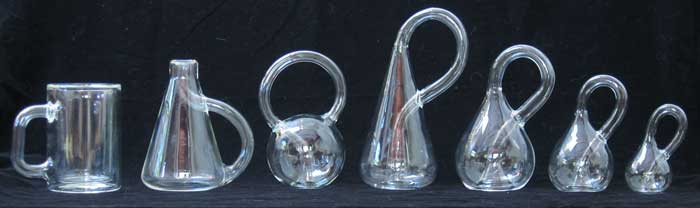
Imagine a circle. Easy. Now imagine a cylinder. Still easy. A Moebius band? Not too difficult once you understand what it is. What about a bottle that has no inside or outside?
Might be a bit harder. Now you are told that the bottle can be constructed by gluing two Moebius bands together along their boundaries. The difficulty mounts exponentially. Computer animation can help.

The smooth, infinitely dense material that is the idealised mathematical surface embedded in space, as well as idealised space itself, has extremely counter-intuitive properties--only more proof, really, that actual matter is discrete, not continuous: you cannot keep breaking it down without eventually reaching some sort of indivisible component. If you could, it would share the bizarre and mind-boggling paradoxes that idealised surfaces, with their continuity, present. There's, for example, the Banach-Tarski paradox: the ball (in mathematics, that specifically refers to the inside of a sphere, a sphere without its skin as it were) can be divided into six pieces, which, after being rotated and moved around in space, then form two balls, each of the same volume as the original.
A only slightly less strange result is a theorem of Stephen Smale which states, among other things, that the surface of a sphere can be turned inside out smoothly. What exactly this means, and how this can be done, is the subject of the illuminating video Outside In.

The video was the work of the Geometry Center at the University of Minnesota (why their site is hosted on UIUC's servers I can't quite fathom). This research centre, which operated from the 1980s till 1998, focused on the 'computation and visualisation of geometric structures'--in other words, using technology to make it easier for us to see what things that the mathematics says must exist, but are too strange for us to imagine unaided. Another of their works, Not Knot, about what we would see if we lived in a space with certain points removed--it's nowhere as simple as just seeing some sort of black hole where the removed point is--is also available as a streaming video.
A good example of technology extending our horizons, no?

Saturday, March 28, 2009

D'OH

'[23:52] [!] Zhuf (3100) Oh well, what the hell.: Proposition: for large enough q, (5*9^q + floor[(162/91) * (10*9^2q-1 + 81^(q-1) )]) ^ 2 \leq 3 ^ (4q+3) + 7 (4q + 3) - 4 \leq (5*9^q + ceiling[(162/91) * (10*9^2q-1 + 81^(q-1) )]) ^ 2
[23:52] [!] Zhuf (3100) Oh well, what the hell.: and now
[23:53] [!] Zhuf (3100) Oh well, what the hell.: we go on holiday
[23:53] [!] Zhuf (3100) Oh well, what the hell.: good day
[23:53] 77/44 - bahdotz...: WAD????
...
[23:54] 77/44 - bahdotz...: wad happens if p is 1 mod 4
[23:54] [!] Zhuf (3100) Oh well, what the hell.: you do get 2 mod 4.
[23:54] 77/44 - bahdotz...: no u dont
[23:54] 77/44 - bahdotz...: if not i would have solved the prob
[23:54] [!] Zhuf (3100) Oh well, what the hell.: yes you do
[23:54] [!] Zhuf (3100) Oh well, what the hell.: why dont you
[23:55] 77/44 - bahdotz...: -.-
[23:55] 77/44 - bahdotz...: something is very strange here
[23:55] [!] Zhuf (3100) Oh well, what the hell.: your mod p argument doesnt work though
[23:55] 77/44 - bahdotz...: 3^p = 3 mod p
[23:55] 77/44 - bahdotz...: 7p = 0 mod p
[23:56] 77/44 - bahdotz...: -4 = -4 mod p
[23:56] [!] Zhuf (3100) Oh well, what the hell.: mm.
[23:56] 77/44 - bahdotz...: sums to -1 mod p
[23:56] 77/44 - bahdotz...: the only p tt satisfies this is p = 3mod 4
[23:56] 77/44 - bahdotz...: or rather
[23:56] 77/44 - bahdotz...: 1 mod 4
[23:57] [!] Zhuf (3100) Oh well, what the hell.: um no?
[23:57] [!] Zhuf (3100) Oh well, what the hell.: like 13 is congruent to -1 mod 7
[23:57] [!] Zhuf (3100) Oh well, what the hell.: but not 2 mod 4.
[23:57] 77/44 - bahdotz...: as in
[23:58] 77/44 - bahdotz...: the only SQUARES
[23:58] 77/44 - bahdotz...: in mod p tt satisfies -1 mod p
[23:58] 77/44 - bahdotz...: is when p is 3 mod 4
[23:58] [!] Zhuf (3100) Oh well, what the hell.: hm?
[23:58] 77/44 - bahdotz...: 1mod 4*
[23:58] 77/44 - bahdotz...: grah
[23:58] 77/44 - bahdotz...: basically
[23:58] [!] Zhuf (3100) Oh well, what the hell.: oh
[23:58] [!] Zhuf (3100) Oh well, what the hell.: hey maybe that was the solution ><.
[23:59] [!] Zhuf (3100) Oh well, what the hell.: go figure.
[23:59] 77/44 - bahdotz...: -.-'

It's like carpet-searching a few hundred square kilometres to try and locate the enemy, and then finding out that he was squatting in your base with a dumb look on his face all this time, because you inadverently took him prisoner-of-war already some time ago.

Friday, March 13, 2009

Imagination and Geometry

Indeed, geometry is not just a discipline, it is an approach. It is not just the study of space, but an unique way of seeing nature and structure: through the visual image rather than cold, abstract logic. Through the act of imagination, in the sense of conjuring up visual images, It turns abstract semi-comprehension into more intuitive understanding. Coxeter was so right.

Monday, March 02, 2009

几何与想像

不久前在网上找到一套标题为《几何与想像》的教学材料,这几天刚开始看仔细看。这套教材相当有趣,它是由四名很有成就的几何学家编的(其中包括约翰 · 康威和威廉 · 瑟斯顿),用于明尼苏达州立大学的几何中心开办的一门课程。课程标题同样为《几何与想像》,名副其实,它的主要目的在于启发与提升学生、读者在几何方面的想像能力,让他们从而对各种几何形状与几何概念获得更深、更全面、更扎实的了解。
例如教材前面部分有一系列关于正多面方体(即柏拉图立体)的问题。让正四面体竖立在一个顶点上,其最高点与最底点半当中的横截面回呈现什么样的形状?让正八面体卧在一面上,同样的横截面又会呈现什么形状?在正十二面体的二十条边上行驶,能否找出一条路,让我们从一个顶点开始,当中没有重复地探访所有其他顶点,最后回到我们原来开始的顶点?若是二十面体呢,我们能从它的三十条边中拼出这样的一条路吗?
思考着这些问题时,我对这些立体奇特的素质有了深深的体会。Their symmetry is truly startling. The same number of edges and faces meet at any one vertex, at the same angles. Each of the Platonic solids thus looks exactly the same from any one of its vertices, or from any one of its edges, even the icosahedron with its thirty edges and twelve vertices. There isn't only symmetry in each of them, there's symmetry among the five of them: the dodecahedron has twelve faces and twenty vertices, the icosahedron twenty aces and twelve vertices, and both have thirty edges. Their graphs are dual. Same for the octahedron and the cube ... and the tetrahedron is its own dual. When such symmetry as such, in dry, compact words, it is merely an interesting fact. When one discovers it for himself (or herself) in the process of visualising, realising these solids in the mind's eye, it becomes an source of sheer wonder.
在这以前两个星期还在做竞赛题目,做到头昏脑胀还做不出。通常思考到后来就开始思路模糊不清,已经被发现行不通的旧思路反复地在脑子里转,新思路怎样也想不出。归根结底,大概是因为不完全理解而缺乏想像力。不了解题目的根本,没有想像力得出新的思路,结果一直钻牛角尖,捉不住解题的关键。
在这样的情况下,预期继续闷头死做题目,远远不如通过类似与《几何与想像》的教材来培养想像力与数学直觉。

Sunday, February 22, 2009

Vindication of Title

As anyone who has ever taken the time to look at one of nature's fine works might have suspected, all trees really are graceful. This means that, among other things such as olive trees, firecrackers and caterpillars, all lobsters are indeed graceful. It also this page should no longer be there. Well done, Gilbert.

Edit: The post might have been a little premature because the proof really seems quite sloppy.

Saturday, January 03, 2009

Quite Cool


'De Bruijn graphs are ideal for people who are easily lost. No matter where you happen to be in a de Bruijn graph you can always get to your home node, whatever it might be, by calling its name. From whatever node you find yourself at, just follow the path whose label is the name of the node you wish to find and it will take you there, as if by magic.'