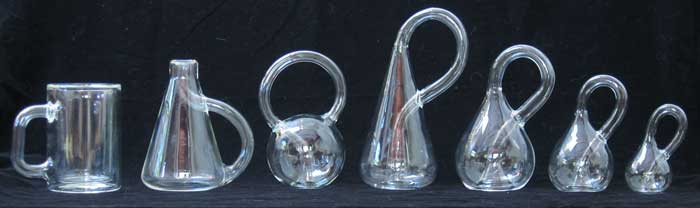
 Might be a bit harder. Now you are told that the bottle can be constructed by gluing two Moebius bands together along their boundaries. The difficulty mounts exponentially. Computer animation can help.
The smooth, infinitely dense material that is the idealised mathematical surface embedded in space, as well as idealised space itself, has extremely counter-intuitive properties--only more proof, really, that actual matter is discrete, not continuous: you cannot keep breaking it down without eventually reaching some sort of indivisible component. If you could, it would share the bizarre and mind-boggling paradoxes that idealised surfaces, with their continuity, present. There's, for example, the Banach-Tarski paradox: the ball (in mathematics, that specifically refers to the inside of a sphere, a sphere without its skin as it were) can be divided into six pieces, which, after being rotated and moved around in space, then form two balls, each of the same volume as the original.
 A only slightly less strange result is a theorem of Stephen Smale which states, among other things, that the surface of a sphere can be turned inside out smoothly. What exactly this means, and how this can be done, is the subject of the illuminating video Outside In.
The video was the work of the Geometry Center at the University of Minnesota (why their site is hosted on UIUC's servers I can't quite fathom). This research centre, which operated from the 1980s till 1998, focused on the 'computation and visualisation of geometric structures'--in other words, using technology to make it easier for us to see what things that the mathematics says must exist, but are too strange for us to imagine unaided. Another of their works, Not Knot, about what we would see if we lived in a space with certain points removed--it's nowhere as simple as just seeing some sort of black hole where the removed point is--is also available as a streaming video.
A good example of technology extending our horizons, no?


1 comment:
That first video was really mind-bending o.OOOOO
Post a Comment