Showing posts with label Musings. Show all posts

Sunday, February 05, 2023

Part 1

In an ideal world the status quo in Taiwan would be maintained indefinitely and nobody would make any provocative moves, there would be no war in Ukraine, the Scots and Catalan would amicably negotiate their independence, and the indigenous peoples of North America would exercise meaningful sovereignty over their ancestral lands. There's a long way to go between where we are and that ideal world, and lots of obstacles and problems in between. It's complicated, and I don't have any good ideas for how to get from here to there. To conclude that we should give up on the ideal, though, seems like just learned helplessness and defeatism. 

I understand better now the bit about the parent saying their child should be a communist as a youth, but not when they get older. It's not a matter of right or wrong, the parent is just exasperated that their child, after decades of living through the world as it is and maybe frustration that it's not changing nearly as quickly or as much as they want, still believes that we should or can try to seriously change things. 

But these are all matters of [differences of] opinion.

Sunday, March 20, 2016

Ignorance and bigotry are like cancers

And we should treat them like we treat cancers, or other diseases of the body. Not with outrage and loud denunciation, or at least not with those alone. Those might be useful for drawing attention to the problem, but they're not going to make it go away.

No, we should study them closely, and understand deeply their origins and how they grow and spread. We should use this knowledge to systematically and methodically eradicate them, the same way we have eradicated smallpox and are so close to eradicating polio. 

Tuesday, August 18, 2015

But is it better to let never exist?

Clearly you believe that, in the case of commitments you doubt you can honour, the answer is a resounding yes. Even if that exchange on Kenmore did make it seem as though, in general, your opinions were exactly the opposite. 

Wednesday, May 13, 2015

"Oh hello!!!"

Anger and outrage is all very well, but maybe it's more useful to investigate the causes---calmly and systematically, though insistently nonetheless---and address them. Ignorance and myopia and bigotry are scourges, I agree. But they are scourges which we should aim to eradicate, not merely condemn. Unless public condemnation be part of that process of eradication---but honestly I cannot see it being the entire solution in and of itself. 

Monday, February 23, 2015

Ick!

I didn't particular enjoy writing college admission essays---the whole idea of "selling oneself" just didn't quite click. I understand what it is and why it would be necessary, but somehow just. Can't. Bring myself to do it. People should't make judgements about other people based on a small amount of information cherry-picked and presented to them in a short period of time under intense pressure. Such judgements seem to be almost certainly doomed to be bad judgements, on the whole. But well. Such is the way (parts of) the world work at the moment ...
And now I find myself on---not quite the other side, but another side anyway---of the table. Not making admissions decisions, but having to give my evaluation or impression of an applicant based on a small amount of information they cherry-pick and present to me within a short period of time under pressure. An evaluation or impression which will then form part of the small amount of information that the people who actually make decisions will actually see. I'm not particularly enjoying it either.
Talking to those people was fun. Having to evaluate them, not so much. I could be just brutally honest. Some of the applicants I interviewed were really interesting people and had interesting ideas, and those I thought really deserved a shot at admission. Some others just seemed like lost high school seniors. But I feel bad writing that. I don't know whether that would be quite enough to torpedo their chances of admission, but it's certainly not going to help; and looking back, I was probably more like one of them than like the people who had ideas and interesting things to say.
Meh. Maybe I'll just bite the bullet and do that (in more diplomatic language.) I'm sorry, but at the end of the day I'm not responsible for the dizzyingly low admission rate.
I guess what you really should do, if you feel bad about hindering these kids, is to address the issue of educational (in)equity more broadly and think about broadening opportunities and access to education at a level comparable to Princeton ... 

Saturday, January 03, 2015

Finely-tuned apathy

Does it strike you that there is a slight resemblance between (a) what you regard as your parents' mildly unhealthy attachment to you, (b) what your students might regard as your being too demanding / micromanaging in your concern for their grades, and (c) what you perceive as someone caring too much about what his class thinks about him?
In all of these cases, there's one party which holds itself responsible for some aspect of the other, expects that to be reciprocated to some extent by some form of appreciation, and is duly nonplussed (and a little upset) when that appreciation does not quite materialise---but have they taken into account how the counter-party feels about this whole rather paternalistic setup?

Part of a conversation I'm having with 2012 me

I believe that nation-states are legal fictions and artificial constructs, whose current shapes and peculiarities are but accidents of history. Lots of people---most people---would disagree, perhaps vehemently so. But that is only because of a lack of clear thought, often encouraged by politicians and regimes for reasons of their convenience.
Certainly there should be some sort of apparatus to give a coherent organization to society, and the modern nation-state, where it works, does this very well. But also we should recognize that nation-states, as such, are nothing more than conventions of convenience. Why should we get so worked up and excited about mere conventions? I don't understand.
Well as you quite rightly point out there is no one natural way of organising human society; what we have is, perhaps, not as good a solution as could ever exist, but it is what it is. Accidents of history and mere conventions by agreement they may well be, but the fact of their existence, the miracle, minor or less minor, that they have been conjured, willed, brought into existence, is surely worth something,
So, perhaps, these things are worth celebrating and worrying about. Though, also, it behooves us not to take them too seriously, for there are, ultimately, higher and more important things in this world than country. 

Monday, August 18, 2014

What is loyalty, anyway

Where does it stop? What if you grow apart? What if time has changed you so much you are no longer recognizable to each other?
It shouldn't matter, says one answer. Loyalty should never stop. And I think there's a grain of truth in that.
But then, if you say it never stops: at what point does it become blind and meaningless?
It doesn't, would be the only logically consistent answer. But that cannot be all there is to it. That would be far too simple.
If someone has changed beyond all recognition, thoughts, beliefs, values, habits, and all, is s/he really still the same person? To insist that s/he is---should that be seen as a necessary kindness rendered to him/her, or a grave disservice, or perhaps an unnecessary and silly mistake?
And, in particular (a bit of a leap, but I started out pondering these questions and somehow got to those other questions above), how hard should we hold on to those who are about to leave? Yes, they were very kind to us. Yes, we owe a great debt of gratitude to them. Yes, we would all be happier if they weren't leaving. But we are all mortal, after all. And at the end of the long, long day, when it almost seems like they have decided it's time to leave, how hard should we fight that judgement that they make?
Maybe there just are no universal answers. We can only give the benefit of the doubt, and navigate each individual conundrum as (or hopefully before) it comes into sharp, uncomfortable focus.

Sunday, May 18, 2014

More inchoate thoughts

Some days I wake up with a fire burning inside ... that usually dissipates by the time I finish brushing my teeth. Oh well. Pity, some of that fire might actually motivate me to do something useful in life.
I'm going to write down some of the thoughts that stick for those 15-to-30 minute intervals, and maybe that part of me that mediates the daily hustle and lets it take over before breakfast is over will pick up on some of them and decide to do things with / about them.
It bothers me that the society we live in (broadly speaking) is so unfair. Maybe it's just the way the world is. But I don't believe it's the way the world must be.
There is not enough empathy in this world. There should be more. I should do something about it.
Elon Musk is doing awesome stuff. There're all these shops shuffling digits around in some form or another, and then there's Tesla and SpaceX. I should get on his level.
I should make it a life-goal to learn (and retain!) as many languages as possible.
Maybe you are more than your work. Maybe you can still be the change you want to see even if you don't choose to become a social activist or political organiser. 

Wednesday, April 02, 2014

Things I Realized Today

PricewaterhouseCoopers is a privately-held company. So is Koch Industries. So are many firearms manufacturers. Any number of the interesting firms lobbying Congress are privately-held and so don't (aren't oblige to) disclose very much information about themselves. At which point the study of money politics goes back squarely into the shadows of murk, estimation and guesswork. Or maybe there's a way to scrape all that information off the massive hairball of information that is the Internet. That would be one hell of a scrape though.

Saturday, August 31, 2013

Meh

You know what? Being an adult is completely overrated. Conventionality can go stuff itself. And as long as you uphold your responsibilities, growing up can go stuff itself too. 

Monday, July 01, 2013

Less nostalgia more giant shopping malls

That seems to be the way things are going anyway. Is this kind of homogenisation inevitable? (Certainly it's not just happening where you are.) Is it really undesirable, and if so how? Discuss.

Friday, May 24, 2013

Why do you travel?

To see how wide and wondrous the world is, but also how familiar it can be and how humanity has so much in common.
To experience the new and unfamiliar, to challenge my own comfortable assumptions, to make myself uncomfortable.
To learn the meaning of hospitality and friendship, to learn from and about those around me, in a deep, significant, and meaningful way.

Friday, April 26, 2013

Inchoate Thoughts

Let me speak frankly and bluntly. There are some things that have been bugging me every so often, and maybe if I put them out here in the open---so to speak---I will have a better grip on them and eventually figure out how to deal with them more productively.  Most of this is going to be not very coherent, possibly, and disjointed, and involves a probably inane amount of navel-gazing---so in case I have actually decided to hit "Publish" on this one and you are reading this, be warned that it may not be all that exciting a read. But anyway:
First, possibly foremost: I am terrified of the future. I have no idea what will happen after I graduate. It feels like jumping off a cliff with no inkling of what is ahead or below me, with no parachute, jet-pack, trampoline, or safety net of any kind to catch me. Sometimes I think I'll be fine as long as I keep working and look to see where I'm going. Other times (usually after I talk to the parents) it seems like the path I choose is going to be terribly difficult and that there is every chance that I will fail no matter how hard I try. I don't think that's true; or at least, I hope that's not true. Rationally I figure that it's probably not true, but there's always a nagging shadow of doubt somewhere in the corner of your mind that says, not quite "the naysayers are right", but "what if they're right? What will you do then? I think there's a small but significant chance that they are. Shouldn't you be doing something about this?" Does that sound like someone in denial? Maybe. Maybe it's really saying "the naysayers are right" but the rest of your mind is fighting that notion as hard as it can.
Which brings me to number two: I am perpetually haunted by a mix of extreme nihilism and existentialism, something which is tremendously liberating but also terribly draining. What is the meaning of life? There is none, is my usual answer. You can choose either to be a pawn of your evolutionary instincts, an instrument of biology; or you can define yourself by what you do. But---then it's probably a natural question to ask---what is the point of defining your own purpose in life when nobody else will share in it or affirm it. And thus "defining your own purpose", usually, devolves into defining yourself by your work, by what others think of it, and/or even by what others think of you. At which point you open yourself up to all kinds of stresses and upsetting things that should not disturb you so unduly. But then again maybe that's not all a bad thing. Or maybe you should just learn to be more at peace with these things which you now think of as stressors pure and simple. Maybe you just need to broaden your sense of purpose in life, but also to become more comfortable with failure, or perceived failure.
One reason why you're not is the persistent and recurring perception that you "cannot afford to fail" any more. Maybe that's true. More often it's not, and in these circumstances it does not help you at all to think that way (it's probably not very helpful even when it is true ... ) Sometimes you need to do some worrying, but afterwards you should throw the worrying out the window, set your mind at peace, and just go. If you fail---when you fail---then you'll have time to figure things out and try and solve the problem. In the meantime that worrying is preventing you from doing as much as you could, and causing you unnecessary stress.
These thoughts usually intensify---and present themselves in the form of mild panic attacks---around the bits of free time during summer, and/or after long calls with your parents. They usually go away during the semester, more than anything because they get buried by immense amounts of work and busyness. That is unpleasant in its own sort of way, but also nice, in a way. But it also means that you aren't actually addressing these questions and concerns, but only deferring them to a later time, when they will present themselves even more urgently.
I know my parents raise these issues out of genuine concern. Sometimes I question whether that concern is as much for their own future financial health as for me, but perhaps these questions are best left unasked and unaddressed. In any case never have I doubted that they do care for me, and they have really been very supportive if you think about it. Still ... zaten ... however reasonable I find their proposals, some part of me just categorically refuses to adopt them. Yes, they have more experience; but not all of that experience necessarily applies to your world today. Maybe ... maybe you just need to accept that, and its consequences, whole-heartedly, and work on that basis. At the moment it's more like you are in two minds: on the one hand you disagree with what your parents say and consequently part of your mind refuses to hear anything of it; on the other hand you fundamentally respect what your parents have to say and that feeds the voice in your mind that continually questions your own decisions and plans. Maybe what you should do is to take what you hear from your parents as good but not infallible advice, and weigh it objectively with and against everything else you see and hear from everyone else. Stop taking it as dogma that you must accept or fight, and start thinking of it as advice that you receive and weigh.
Talking to the parents also feels draining because they never quite talk to me as an adult. With Mom the nagging never stops; with Dad it takes the form of never quite agreeing with my opinions or even agreeing to disagree. It's annoying, frankly. But more and more I think of these things as just things I have to work around. It's not that they have malicious intentions or anything ... just that parents will always be parents ... 

Friday, April 05, 2013

So many questions to which there is no answer (Response to Tufte)

But yet we must answer them, no? Maybe not conclusively or definitely, but we must have some sort of answer so that we don't stand still or grope around blind.
Surely you know this, because you have been a social scientist before, because you are clearly more than just an armchair academic.
Or maybe you were just trying to say that this sort of ineffability, so to speak, will always be present, all the more acutely so in the social sciences; that we should always be aware of this and that this should be spur us on to be more rigorous, more exacting, and more creative in our methods and thinking ...

Saturday, March 30, 2013

Φιλαδέλφεια

Remember how utterly dead Trenton, or at least the neighborhood where the Social Security office, was? Boarded up houses, no commerce except for discount corner shops and liquor stores, and hardly anyone on the streets; it seemed like the buildings were there not to be lived in and inhabited, but just to provide a picturesque background for all the cars zooming past on their way to other, more interesting places.

A lot of Philadelphia felt the same, somehow. Maybe not so much University City, which was well and alive alright. But so much of Center City even, the blocks near Front Street and Penn's Landing, felt devoid of life.  Even around City Hall, where there were crowds milling around, it felt like the people were only passing through, that there was nothing in this most central part of the city to hold their attention. There is a huge transit concourse running down part of the length of Market Street, I gather; but it doesn't have nearly as many shops or restaurants or buskers or activity as it could have: most of it seemed to be just huge, hulking empty walkways. The roaring of cars was a much more evident sign of human activity than anything human: there were major interstates placed prominently by the rivers.


The whole city gave off this air of neglect and decay. Sure the bits around Independence Hall were nice and 30th Street Station was very stately indeed, but beyond that it didn't feel like very much of a city at all.
Can a city like this, one which doesn't quite bring together people and ideas and communities through interaction and discourse and common experience, even claim to be a city? Surely a city is more than just two million people clumped into a relatively tight space but not really living together in any meaningful sense.

Then again really some of that interaction and discourse does happen, even if it's not as common or fluent as one might wish it to be. And there're also other aspects to it as well I guess. Stadtluft macht frei. Even if a city isn't quite serving some of the functions one might ideally want it to, maybe it can still achieve other things.

I used to be a dyed-in-the-wool urban resident, but now after two-and-a-half years in Princeton I've become rather more indifferent it seems. Then again university towns like this one share some significant similarities with large cities: there's always something going on, especially if you're a student there, and the large numbers of diverse and transient denizens (i.e. students) re-create to some extent the open, dynamic social environment of large metropolitan cities. So maybe I am still an incurable city-lubber, just that I've managed to find the city in Princeton ...

Thursday, January 10, 2013

Call it Douglas Adamism

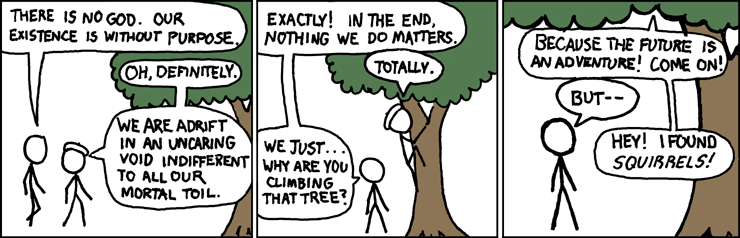
"Life is meaningless. Let's go for lunch." Or, the guy with the beret.
Probably the most accurate description of my life philosophy. 

Sunday, December 16, 2012

From Bonfire and Housewarming

Why all that cheering over a destructive act? Anlamıyorum. And I wonder what those firemen think ... or the town thinks. That bonfire on New Year's Eve in Reykjavik I understood. This one ... well I guess I understand, just slightly less so. Shrug. Maybe it does matter to some (not insignificant number of) people. Maybe that's all that matters.

Another thought ... no-one ever teaches children (or you) about these things called cultural references or frames of reference, things that people take for granted and base their interactions off of ... but what if your upbringing gave you a framework and a set of norms which were both here and there, and hence neither here nor there? Then what?

Then you become a perpetual outsider, embraced neither hither nor yon. There is nothing to be done---you can abandoned your identity to conform to something more familiar (to others); or you can learn to become comfortable with being an outsider. Most people aren't hostile (though some are); they're just not as warm or accepting. But with enough time and effort, you'll find enough warmth to survive on. And then stoic resignation will see you through the rest.

Sunday, November 04, 2012

All beauty and truth

You propose to surrender on everyone else's terms.
I propose to surrender on my own terms.
Maybe what I should really be thinking about is not surrendering.

Thursday, August 09, 2012

47 Years on a Knife's Edge

Happy birthday. It's been a good while now.
Some say you're an anomaly, a freak and accident of history, an artificial and unnatural country. Well, yes, but only, above all, because countries are artificial things by nature, imagined creations of the human mind. It's easier to see that reflected in the case of a tiny, young city-state---but at heart you're not any fundamentally stranger than even the so-called great powers and ancient nations of this world.
That tiny size does unfortunately make you somewhat more vulnerable---though at least insofar as it also makes you acutely aware of the same, it is not, unmitigatedly, a bad thing. We all live on a knife's edge and but by the grace of circumstance---and the more aware of that we are the less complacent and better prepared we'll be. There is no room for complacency. There never will be.